
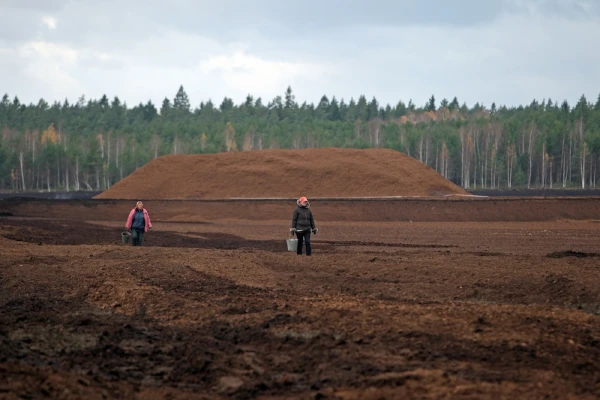
On Thursday, the Saeima adopted amendments to the law on the natural resources tax (NRT), included in the budget bill package, which provide for a fivefold increase in the tax rate on peat starting in 2027 — to 3.5 euros per ton. For unprocessed wood sold for commercial purposes outside the European Union and the European Economic Area, the NRT will be 75 euros per cubic meter, reports LETA.
Simultaneously, starting in 2026, the tax rate on sand and gravel-sand mixture will be increased by 25%. According to the Ministry of Climate and Energy (MCE), the tax will be raised by 10 cents per cubic meter, which will provide additional revenues of 0.5 million euros in the 2026 budget.
Currently, the tax rate on peat is 0.7 euros per ton.
The ministry explains that although the obligations for greenhouse gas (GHG) emissions from peat extraction will come into effect starting in 2026, the increased tax rate will only take effect on January 1, 2027, to allow the industry to restructure and plan its activities.
The peat industry accounts for 10.7% of all GHG emissions in Latvia's national balance annually. According to preliminary calculations, one ton of extracted peat will cost Latvia 25 euros in equivalent GHG emissions. The volumes of peat extraction significantly affect the achievement of climate neutrality, so it is necessary to create fiscal pressure on the industry to reduce extraction.
To avoid shifting the consequences of GHG emissions from peat extraction to other sectors of the economy, the principle of "the polluter pays" is being introduced.
Starting in 2027, a new tax on unprocessed wood harvested in Latvia for commercial purposes, not processed into wood products and sold outside the EU and the European Economic Area, will be introduced. The tax rate will be 75 euros per cubic meter from January 1, 2027, and 115 euros per cubic meter from 2028.
The MCE explains that in 2024, Latvia's forestry sector will still be primarily focused on the primary processing of wood, providing the majority of production and export revenue. At the same time, secondary processing — the production of furniture, paper products, construction structures, and composite materials — occupies a relatively small share of turnover, although there is growth potential in this segment due to the increasing demand for high value-added products and sustainable materials. The Latvian woodworking industry needs to shift from primary to secondary processing to increase added value and economic returns.
One of the goals of the forestry sector is to improve the efficiency of wood resource use, including through the processing of wood waste, broader use of wood as an eco-friendly material in the country's economy, and the creation of stimulating tax policies and other motivational mechanisms.
Annually, about 13 million cubic meters of wood are harvested in Latvia. According to the Ministry of Agriculture, about 300,000 cubic meters of this volume is exported to third countries.
As emphasized by the ministry, the state aims to stimulate the restructuring of the industry towards the production and export of wood with higher added value, which will contribute more to the country's economy.
The Cabinet of Ministers must develop regulations regarding methods for determining the volume of unprocessed wood, as well as requirements for accounting documentation and the content of information confirming the volume of such wood by October 1, 2026.
Payments of the natural resources tax for unprocessed wood in 2027 will be 100% credited to the state budget, and from 2028, 70% will go to the state budget and 30% to the local government budget where the logging took place and the wood was harvested for commercial purposes.











Leave a comment