A bitcoin wallet in 2025 is a must-have for working with cryptocurrency. According to Glassnode, there is the largest decline in BTC volumes on exchange addresses in the last six years — approximately 700,000 coins — and this is not a coincidence. Investors are increasingly relying less on intermediaries and prefer to control their funds independently.
The reason for this phenomenon is simple — centralized exchanges are convenient for trading, but they are not the most reliable way to store large sums. The collapse of FTX in 2022 demonstrated the vulnerability of such platforms: investors' assets worth at least $8 billion were locked after the bankruptcy, and investigations confirmed that customer funds were used by the exchange to cover debts of related entities.
In 2023, the South Korean platform GDAC lost about $13 million as a result of a storage hack: hackers withdrew BTC, ETH, and other coins before the platform could suspend suspicious transactions.
At the same time, the American division of the largest exchange Binance faced claims from U.S. regulators and temporarily restricted the withdrawal of certain stablecoins. This caused a wave of concern among users and once again emphasized that even global platforms depend on external decisions and do not guarantee constant access to funds.
When private keys are held by a third party, the user is not the full owner of their funds. This factor has become decisive for a new wave of crypto investors when choosing a method for storing digital currencies.
Thus began the transition to personal wallets — software and hardware solutions where the owner is fully responsible for the safety of their assets. However, with increased independence came a new level of responsibility: losing the seed phrase and other usage errors can lead to irreversible loss of funds.
In the following article, we will analyze what types of bitcoin wallets exist, how they differ, how to choose the optimal option, and what security measures need to be followed to ensure that using cryptocurrency remains not only convenient but also safe at every stage.
What Types of Bitcoin Wallets Are There?
Before deciding which bitcoin wallet to choose, it is important to understand what types exist and how they differ. Essentially, it all comes down to answering one question: where are the private keys located: online or offline? This determines both the level of security and the convenience of accessing funds.
Hot Wallets are connected to the internet and operate as mobile or desktop applications. They allow for quick sending and receiving of Bitcoin or other cryptocurrencies, making purchases, participating in DeFi projects, or exchanging tokens directly within the interface.
The main disadvantage of this option is the dependence on internet availability and increased vulnerability to phishing and malware. However, even so, hot wallets are safer than centralized exchanges: private keys are stored by the owner, not on a third-party server, so access to funds cannot be blocked externally.
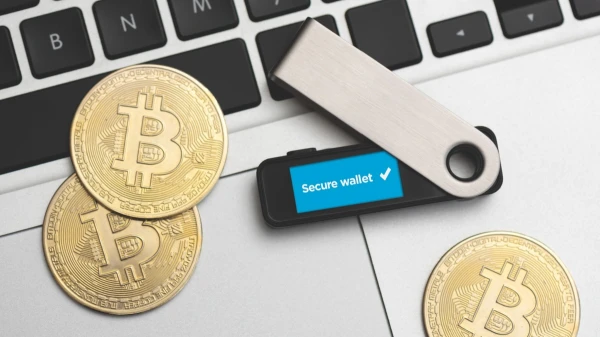
Cold Wallets, on the other hand, are isolated from the internet. These are physical devices, most often resembling a flash drive or a small keychain with a screen, buttons, and a built-in security chip. They connect to a computer only for the duration of signing a transaction, after which the connection is severed. All information about private keys remains inside the device and is never transmitted online.
Cold solutions provide maximum protection, making them suitable for long-term storage of large sums. The main downside is less convenience and more steps required for each transfer.
| Type | Convenience | Security | Level of Control |
|---|---|---|---|
| Hot | High — access via mobile devices and browser | Medium — depends on network and device security | Full, provided that backup keys are stored securely |
| Cold | Low — requires physical connection | Maximum — no internet access | Full, provided that backup keys are stored securely |
Experienced users often combine both types: they keep small amounts in a hot wallet for daily operations and the majority of their assets in a cold wallet, where they are securely protected from external risks. This approach allows for a balance between convenience and security.
In this article, we will discuss how to choose a wallet for specific goals and determine which storage strategy is right for you.
Which Bitcoin Wallet to Choose in 2025
Now that we have discussed the types of wallets and how to use them correctly, let’s move on to specific solutions. We will consider the most popular options for 2025: their features, strengths, and weaknesses.
Best Wallet — a Comprehensive Approach to Storage and Control
Best Wallet is one of the most versatile bitcoin wallets of 2025. The application combines everything needed for working with cryptocurrency: storage, exchange, staking, and access to Web3 projects. It supports over 60 blockchains, including Bitcoin, Ethereum, Solana, and Layer-2 networks.
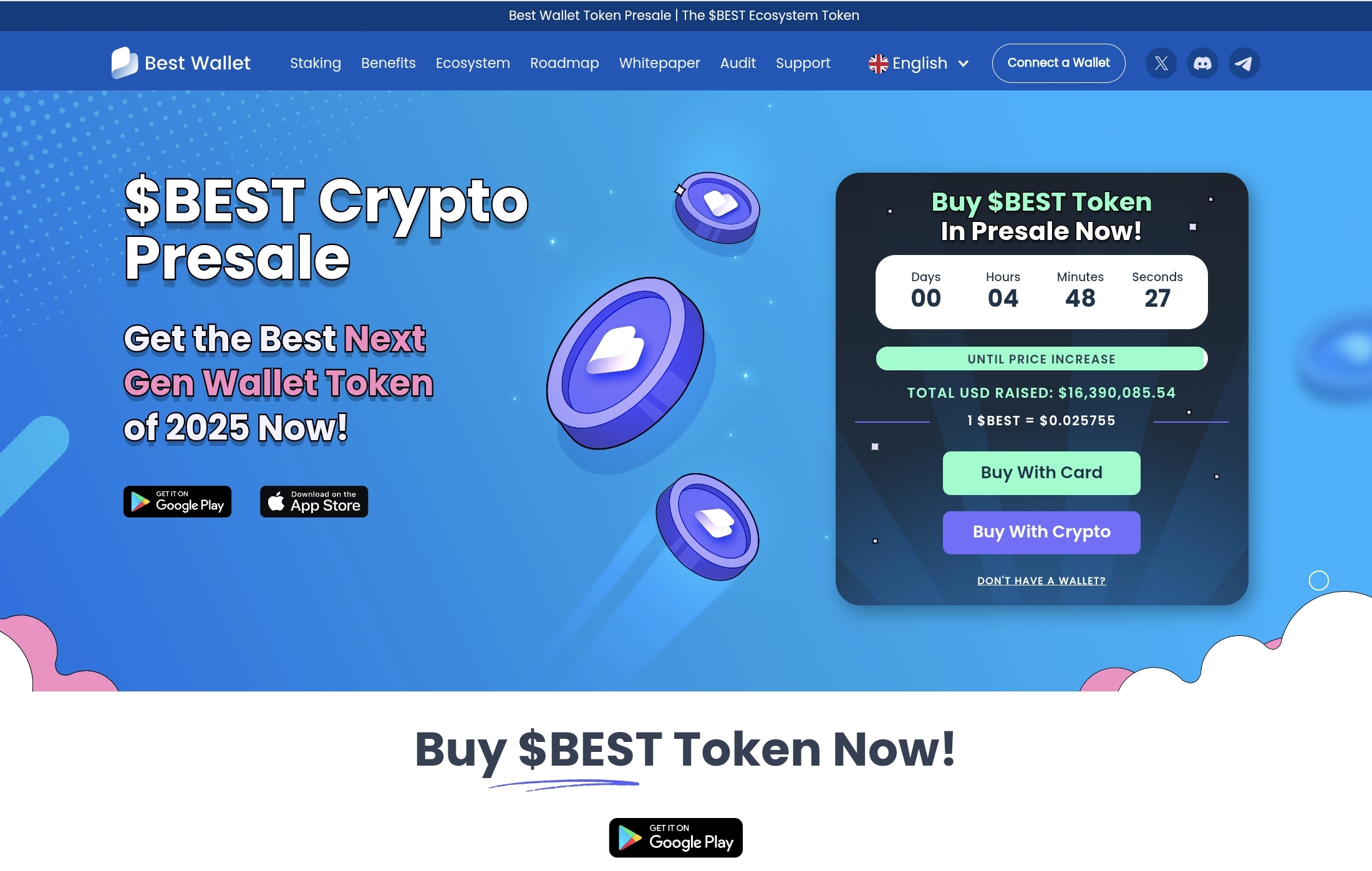
All private keys are created and stored locally on the device, and developers do not have access to them. This means that the user controls their assets without intermediaries and external risks.
Additionally, Best Wallet features two tools that set it apart from other similar solutions. First, there is a built-in exchange where users can safely swap currencies without involving exchanges. Second, there is a section called “Upcoming Tokens”: new tokens on presale appear here, which can be purchased directly within the app.
The ecosystem also includes a DeFi module, an NFT gallery, and staking for the $BEST token with an annual yield of up to 81%. The team is also preparing to launch a crypto card, which will allow users to pay for goods and services with cryptocurrency with instant conversion to fiat.
The interface is user-friendly for mobile devices: clear navigation, PIN code protection, and backup of the seed phrase. The app is available for iOS and Android and is suitable for both daily operations and long-term storage.
Advantages:
-
built-in exchange and “Upcoming Tokens” tab for participating in presales;
-
DeFi tools, NFTs, and staking for the $BEST token (up to 81% APY);
-
upcoming launch of a crypto card for payments in cryptocurrency.
Disadvantages:
-
requires regular updates due to active feature development;
-
currently lacks a desktop version;
Trust Wallet — a Proven Mobile Option
Trust Wallet is one of the oldest and most well-known mobile bitcoin wallets, part of the Binance ecosystem. The app supports 70+ blockchains and thousands of tokens, including Bitcoin, Ethereum, BNB Chain, and Polygon. Formally, it is an independent non-custodial wallet where private keys are stored only by the user; however, the close connection with the exchange draws additional attention from regulators.
The main feature of Trust Wallet is its focus on simplicity and speed. The app allows users to buy cryptocurrency using a bank card, exchange assets directly, send some of them to staking, and connect to Web3 applications through a built-in DApp browser. Users can manage tokens, store NFTs, and use QR codes for quick transfers. The interface is intuitive and suitable even for those who have never worked with cryptocurrency before.
In 2024, the project underwent stress tests: after reports of a vulnerability, the team quickly updated the app and strengthened the security system. Trust Wallet remains a reliable tool, but some users note that updates sometimes come with delays, and technical support does not always respond quickly.
Advantages:
-
support for over 70 blockchains and thousands of tokens;
-
built-in exchange and DApp browser for Web3 projects;
-
simple interface suitable for beginners.
Disadvantages:
-
periodic delays with updates and support;
-
dependence on Binance infrastructure and regulatory scrutiny;
-
limited DeFi capabilities compared to multi-chain solutions like Best Wallet.
Ledger Nano X — the Benchmark for Cold Storage
Ledger Nano X is one of the most well-known hardware bitcoin wallets from the French company Ledger. It is a small device resembling a flash drive, where private keys are stored inside a secure chip that never leaves it. Ledger supports 5,500+ cryptocurrencies, including Bitcoin, Ethereum, Solana, and tokens of ERC-20 and BEP-20 standards.
The wallet connects to a computer or smartphone via USB or Bluetooth and is managed using the Ledger Live app, where users can check balances, sign transactions, and participate in staking. All operations are confirmed manually on the device, without an internet connection, which eliminates the risk of remote hacking.
Ledger Nano X is designed for users who store large volumes of assets and prefer full control over them. Thanks to the built-in battery and Bluetooth module, the device remains convenient even when used with mobile devices. In 2023, Ledger added the ability to recover the seed phrase through cloud backup, but due to negative community feedback, this feature was made optional.
Advantages:
-
maximum level of security and offline key storage;
-
support for over 5,500 assets and integration with Ledger Live;
-
staking capability and Bluetooth connectivity to mobile devices.
Disadvantages:
-
high cost compared to software wallets;
-
not suitable for frequent transfers and quick transactions;
-
requires basic technical skills for setup.
Exodus — a Visually Intuitive Multi-Currency Wallet
Exodus is one of the most user-friendly and intuitive bitcoin wallets for beginners. The app features a bright interface that helps visually track balances, charts, and portfolio structure. It is a multi-currency wallet supporting over 300 assets, including Bitcoin, Ethereum, Solana, and popular ERC-20 and BEP-20 tokens.
The main advantage of Exodus is its simplicity. Users can see all operations in an intuitive interface, without complex technical terms and settings. The app is available not only on mobile devices but also for desktop (Windows, macOS, Linux).
Exodus is a non-custodial wallet, and private keys are stored on the user's device. However, unlike solutions like Ledger or Best Wallet, Exodus does not have open-source code, and its security largely depends on the device's operating system. Therefore, it is considered somewhat more vulnerable to potential attacks.
The wallet has a built-in exchange, supports NFTs, and allows connecting Ledger hardware devices for additional security. For users taking their first steps in cryptocurrency, Exodus remains one of the most friendly solutions on the market.
Advantages:
-
clear visual interface, convenient for beginners;
-
availability of a desktop version and synchronization with the mobile app;
-
built-in exchange and NFT support.
Disadvantages:
-
partially closed source code;
-
dependence on device and OS security;
-
lower level of protection than hardware wallets.
Comparison of Popular Bitcoin Wallets
| Parameter | Best Wallet | Trust Wallet | Ledger Nano X | Exodus |
|---|---|---|---|---|
| Type | Hot, multi-chain | Hot, multi-chain | Cold, hardware | Hot, multi-currency |
| Format | Mobile app (iOS/Android) | Mobile app (iOS/Android) | Physical device (connects to phone and computer via Ledger Live app) | Desktop and mobile apps |
| Supported Networks | 60+ blockchains | 70+ blockchains | Fixed set of popular networks in Ledger Live | 50+ networks (Web3, EVM, and others) |
| Control Over Keys | Full — keys stored locally by the user | Full — keys stored locally by the user | Full — keys remain inside the device | Full — keys stored locally by the user |
| Main Features | DeFi, NFT, staking $BEST, exchange, multi-chain, access to presales, crypto card (in the future) | Exchange, staking, DApp browser, NFT, card purchase | Storage, staking (ETH, SOL, DOT), Bluetooth, management via Ledger Live | Exchange, staking (ADA, SOL, ATOM), NFT, visual portfolio |
| Security | High | Medium | Maximum | Medium |
| Interface | Modern and mobile | Very simple and clear | Requires initial setup | Visually clear, intuitive |
| Who It’s Suitable For | All users, including active investors and traders | Beginners and users who value simplicity and speed | Experienced users and long-term holders | Beginners and moderately experienced users |
How to Choose a Bitcoin Wallet?
The choice of solution directly depends on what tasks you plan to accomplish with it. Some make dozens of transactions a day, some store coins for years, and some work with multiple networks at once. The optimal option is the one that fits your usage scenario, and here are a few points to consider:
1. Frequency of Operations
If you frequently make transfers, pay for purchases, or work with DeFi applications, choose a hot wallet with quick access and easy management. It should allow you to send funds in a couple of clicks and support QR code scanning.
Best Wallet or Trust Wallet would be suitable: both have a clear interface and work on mobile devices. For active users, it is also important that the app automatically creates a backup of the seed phrase and supports a PIN code for access.
If operations are rare and the goal is simply to store Bitcoin (BTC), a hardware wallet like Ledger would be more appropriate. It needs to be connected to a computer only during the transfer, while the private keys remain offline.
2. Volume of Assets
For small amounts, use mobile or web applications: the risk is limited, and they are easier to use. If you hold significant volumes of cryptocurrency, choose cold storage. Hardware devices like Ledger or Trezor do not connect to the internet, which means they maximize asset protection even in the event of a computer hack.
3. Multi-Currency and Integrations
If you work not only with Bitcoin but also with other cryptocurrencies, a multi-currency hot wallet would be suitable. For example, Best Wallet supports over 60 networks, has an internal exchange, and allows purchasing cryptocurrency with a bank card. This is convenient for users who frequently interact with different tokens.
Cold wallets can also be multi-currency, but they do not have built-in exchanges: to conduct a transaction, the device needs to be connected to a computer and the operation must be confirmed manually.
4. Level of Control and Experience
Beginners should choose apps with an intuitive interface — large buttons, visual prompts, and step-by-step seed phrase backup.
Exodus is a good example: the wallet explains each step in detail, helps write down the recovery phrase, and warns if it is not saved. The user sees all actions visually, without the need to manually confirm technical parameters of the transaction.
For advanced users, flexibility and independence are more important than simplicity. Ledger allows users to manually verify destination addresses directly on the device screen, connect directly to the blockchain without intermediaries, and work with multiple accounts. There is more manual control here, but also a higher level of security.
How to Secure Your Bitcoin Wallet and Avoid Losing Access to Funds
In terms of the reliability of cryptocurrency storage, not only the choice of wallet matters but also the correct security settings. A few simple rules regarding this aspect help eliminate most risks:
1. Seed Phrase
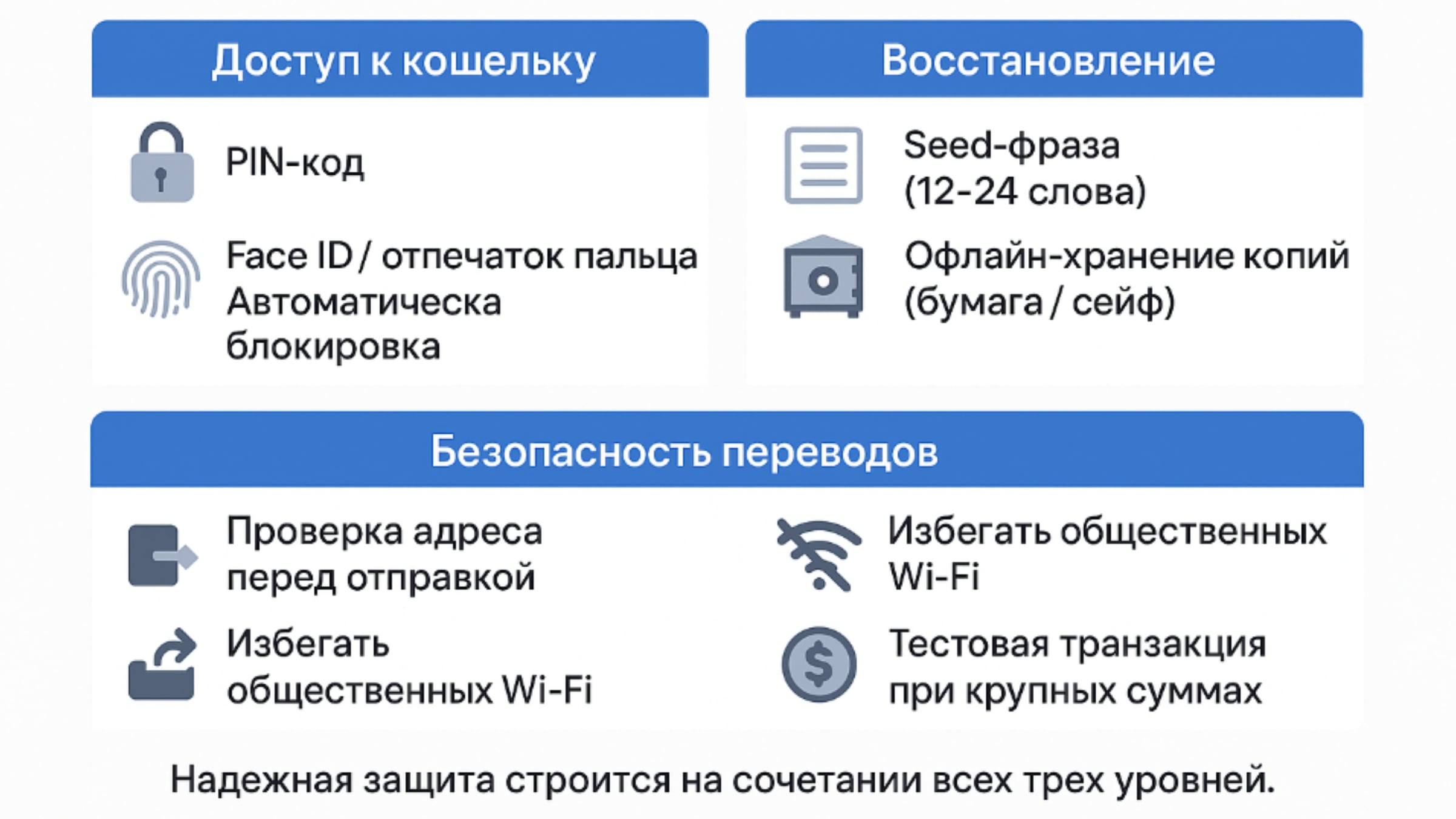
The seed phrase is a set of 12–24 words that provides full access to your funds and allows recovery of the wallet if the device is lost or damaged.
Keep it only offline. Write it down on paper, make a duplicate, and store copies separately in secure locations (for example, in a safe or a bank vault). Do not take photos, do not save it in messengers or cloud services: third parties may gain access to it. If the app offers to create an encrypted backup, use the option only with the PIN code/biometrics enabled.
2. Access
A PIN code is needed so that no one can open the wallet on the device without your knowledge. Choose complex combinations and enable app lock when inactive. For additional protection, activate fingerprint or Face ID access. Also, regularly update the app and operating system: this closes vulnerabilities through which malware can access data.
3. Address Verification and Security During Transfers
Always verify the beginning and end of the recipient's address. Fraudsters may substitute the address in the clipboard or in the QR code using malware. For large sums, it is advisable to make a small test transaction before sending the full amount. Additionally, it is better not to use public Wi-Fi for cryptocurrency operations.
Quick Security Checklist
-
Write down the seed phrase manually and store it offline.
-
Use a complex PIN code and biometrics.
-
Verify the recipient's address before sending.
-
Do not make transfers over public networks.
-
Update the app on time.
Which Bitcoin Wallet to Choose? Conclusion
In 2025, a wallet has ceased to be just a storage tool — it is now a way to manage capital without intermediaries. The higher the level of protection and transparency, the safer your assets will be.
Best Wallet offers a balance between security and a wide range of features, making working with cryptocurrency familiar and fast. Trust Wallet is suitable for those who value simplicity and do not want to delve into technical details. Ledger Nano X remains the choice for those who store large sums and prefer offline protection, while Exodus is a compromise between functionality and clarity.
The main rule is that control must remain with the owner. Regardless of the chosen format, only access to private keys guarantees full ownership of one's funds.