
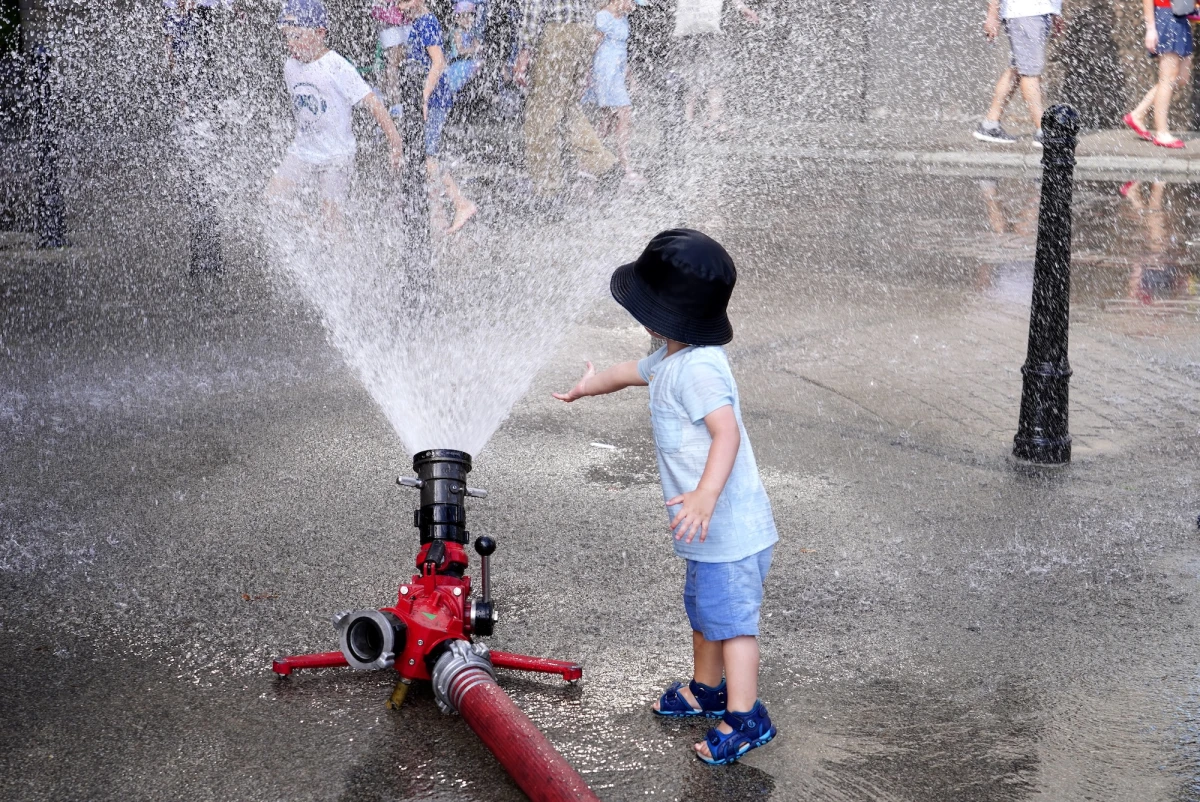
Climatologists warn: a whole series of extreme weather events is brewing as a powerful El Niño overlaps with global warming.
In the next five years, the Earth is very likely to repeatedly exceed the established safe international climate threshold and will likely break the record for the hottest year, according to new climate forecasts from the UN.
The World Meteorological Organization (WMO) also predicts Arctic overheating, with temperatures rising by nearly 1.66 °C between now and 2030, and dangerous droughts with possible wildfires in the Amazon, a crucial part of the Earth's natural defense against human-caused climate change.
Forecasts from the UN climate agency and the UK Met Office indicate a 75 percent probability that the average global temperature will exceed 1.5 °C from 2026 to 2030 compared to pre-industrial levels. This threshold is the maximum level of warming agreed upon in the 2015 Paris Climate Agreement, averaged over 20 years.
How Hot Will the Next Five Years Be?
There is a 91 percent probability that at least one of the next five years will exceed the 1.5 °C threshold, and an 86 percent probability that one of those years will break the record for the hottest year on Earth set in 2024, warns the WMO report.
The WMO also suggests that each year from now until 2030 will be 1.3–1.9 °C warmer than at the end of the 19th century.
"It is important to understand that 1.5 °C is not a cliff we are about to fall off," says report co-author, climatologist Melissa Sibruhk from the UK Met Office. "Every additional 0.1 degrees leads to increasingly severe consequences."
"A Whole Range of Extreme Weather Events"
The UN report, published several years later, detailed that exceeding the 1.5 °C mark means a higher likelihood of deaths, threats, and species loss. And although it is only a few tenths of a degree, some of the planet's ecosystems, such as coral reefs and glaciers, cannot withstand this burden.
Climatologist Friederike Otto from Imperial College London, who was not involved in the WMO report, warns that a whole year or more at temperatures above 1.5 °C will result in "a whole range of extreme weather events that will surpass anything we have seen before," and cities are catastrophically unprepared for this: Many people will die. We can expect sharp spikes in food prices and even more intense wildfires.
Europe has already been urged by the UN to "end its dependence on fossil fuels," as vast areas of the continent continue to suffocate under exhausting heat. Both France and the UK recorded the hottest May day on record this week, while even cooler regions like Oslo faced temperatures significantly above the climate norm for this time of year.
"This record heat bears the fingerprints of climate change everywhere," says Otto.
"Such temperatures were once considered exceptional even in the height of summer. To see 35 °C in the UK in spring is truly astonishing, but the science is unequivocal: climate change is making these heatwaves stronger, longer, and much more frequent."
Is El Niño Responsible for the Record Heat?
Virtually all short-term forecasts indicate the formation of a strong El Niño - a natural warming in part of the central Pacific Ocean that alters weather worldwide and leads to spikes in global temperatures.
The WMO report states that this phenomenon could last until 2028. Therefore, notes Sibruhk, 2027 is likely to break the temperature record set in 2024.
A strong El Niño "can significantly impact the risk of wildfires in the second half of the year," says Dr. Theodore Kipping from Imperial College London. "And while in many parts of the world the global fire season has not yet peaked, such a rapid start combined with the forecasted El Niño means we may face a particularly tough year for fires."
Wildfires kill people not only at the moment when the forest is burning: they degrade air quality for hundreds of kilometers around, causing numerous health problems. For instance, the Australian fires of 2019 claimed 33 lives, but the smoke they generated over the following six months caused 417 excess deaths and thousands of hospitalizations.
Some meteorologists estimate that a typical El Niño episode usually leads to a temporary increase in global average temperature of 0.1–0.2 °C. However, this is not significant compared to the temperature rise fueled by human activity and climate change, which has already raised the Earth's surface temperature by about 1.3–1.5 °C compared to pre-industrial levels.
"El Niño is a natural phenomenon," explains Otto. "It comes and goes. Climate change, on the other hand, will continue to worsen until we stop burning fossil fuels. So it is climate change that is the cause for real panic."
And while Europe suffocates under scorching temperatures, some climatologists debate whether global warming is accelerating at all. According to Sibruhk, this is "very scary," but future temperature readings may put an end to such assessments.
Accelerating Warming in the Arctic
Extreme temperatures are not only being prepared for in the Mediterranean region.
Forecasts based on averaging around 200 runs of computer simulations using 13 different climate models from various countries show that warming in the Arctic is occurring 3.5 times faster than in the rest of the world, as the ice and snow that reflected solar radiation into space are diminishing, explains Sibruhk.
Winters in the Arctic from 2020 to 2025 were on average 1.2 °C warmer than in 1991–2020. The WMO predicts that the next five winters will be on average 2.8 °C warmer than this recent benchmark, adds Sibruhk.
The report also predicts further reductions in the area of Arctic sea ice in summer.
Harsh Warning for the Amazon
The report forebodes even hotter and unusually dry conditions in the Amazon basin, which could have devastating consequences for both local residents and the planet as a whole.
People depend on the Amazon as a source of water, and hotter and drier conditions will increase the risk of wildfires, says Sibruhk, threatening to turn the Amazon, which currently absorbs heat-trapping carbon dioxide from the atmosphere, into a region exacerbating the problem.
The Sahel region in Africa, which is already particularly dry, is likely to receive more rainfall than usual, which could lead to flooding, warns Sibruhk.











Leave a comment