
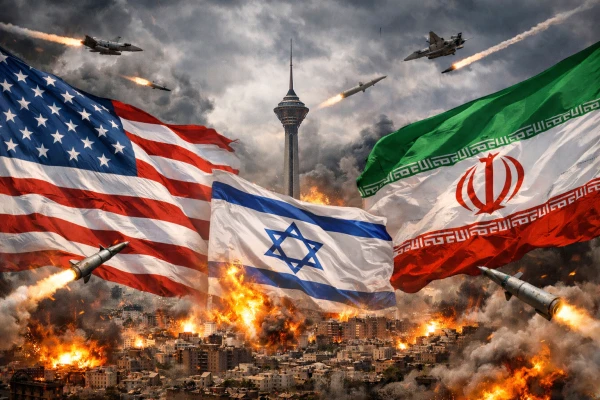
The echoes of the war in Iran have reached Latvia — in the form of rising fuel prices. A jump in inflation is ahead.
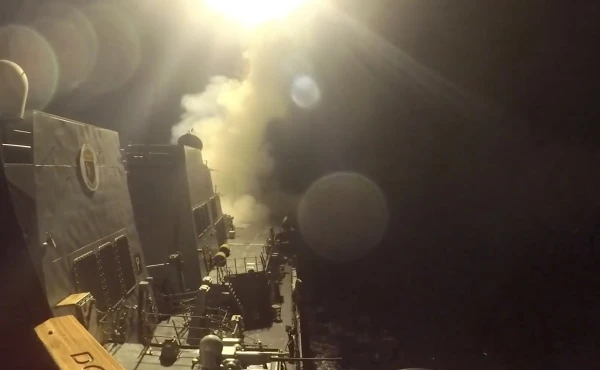
It has been almost two weeks since the military operation by the United States and Israel against the Iranian regime began. When this operation will end is still unknown, just as Trump has not defined its ultimate goal(s).
It is unclear what Trump wants — is it only about the complete cessation of Iran's nuclear program or about stopping support for terrorist organizations (Hamas, Hezbollah, etc.)? Or maybe it’s about regime change in the country? Nevertheless, it is already possible to draw the first direct and indirect conclusions from the nearly two-week campaign.
First conclusion. The head of the White House has shown that he can act quickly, decisively, and effectively, and if necessary, even without seeking permission from Congress.
Second conclusion. In the context of complete helplessness and double standards of the UN, it is precisely the United States that is the only real power capable of acting independently, using not only sanctions or threatening statements but also military force.
Third conclusion. The United States, if necessary, is capable of conducting large-scale military operations without relying on NATO allies. NATO cannot do without the United States, but the United States can easily operate without alliance members.
Fourth conclusion. The current situation has clearly demonstrated the level of influence of European powers on events in the Middle East — this influence is close to zero. The first to "wake up" was French President Emmanuel Macron, who "threatened" to increase France's nuclear potential and to defend his EU and NATO allies more vigorously. Of course, this is a step in the right direction, but it will only increase France's influence over countries on the European continent.
Attempts by Macron to influence Iran are doomed to failure. It sounds particularly strange for Macron to call on Iranian President Pezeshkian to stop shelling the Gulf countries and immediately unblock the Strait of Hormuz. With the same success, the French head of state could address the UN or Sportloto: the Iranian president is de facto unable to influence the decisions and actions of the fanatics – the guardians of the Islamic revolution.
Fifth conclusion. Iran, unable to resist the might of the United States and Israel, has chosen a rather cunning tactic. Namely: to sow chaos in an entire region — it has begun to shell Gulf countries with rockets and launch drones, even targeting former allies of Iran. Qatar and Kuwait have also been caught in the crossfire, while the United Arab Emirates continue to face relentless attacks.
In this way, Iranian fanatics wanted to kill three birds with one stone. First, to show that all those who in any way assist the United States in the region (directly or indirectly) can become targets for Iran.
Second, these attacks were intended to pressure these countries to push the United States to halt its operation and come to the negotiating table.
And third, Iran wants to create the appearance of a third world war and provoke negative economic consequences for both the region and the world as a whole. For this same purpose, Iran began to block the movement of oil tankers through the Strait of Hormuz.
Sixth conclusion. Iran's closest allies have decided to act on the principle of "charity begins at home" and have limited themselves to condemning the "unprovoked aggression of the United States" and expressing condolences over the death of Ayatollah Khomeini.
Seventh conclusion. Judging by everything, the military operation will bury Iran's attempts to acquire nuclear weapons for a long time. It is clear that the new leadership of Iran will have to be less radical — both towards its own population and towards the outside world and its "enemies." After all, the main thing for the regime is to maintain power.
The thing is that Iran is not Venezuela, and achieving some cooperation will be extremely difficult: after all, religious fanatics are in power in Iran, not cynical corrupt pragmatists as in Venezuela. Moreover, the scales of Iran and Venezuela are incomparable.
Eighth conclusion. At the moment, there is no indication that the ruling regime in Iran can be quickly changed. The internal opposition is fragmented, lacks an organizing force, and is weak. Moreover, the moment has been missed — perhaps the military operation should have started when thousands of Iranians took to the streets and a revolutionary situation was almost created.
Miracles do not happen: a regime can only be changed in three ways — through a palace coup, by revolution (coup, civil war...), or from outside. A palace coup seems unlikely for now, a revolution from within appears impossible in the near future, and the option of changing power from outside, that is, through a ground military operation, although possible, is unlikely to be decided upon by Trump. After all, this entails huge casualties with an uncertain outcome.
But, as they say, you cannot change power from the air. Although... the operation of Israeli intelligence to locate where Khomeini and his associates are hiding shows that anything can happen...
Ninth conclusion. The Gulf countries that have been subjected to Iranian aggression may reconsider their foreign policy and reduce their sympathies, and most importantly — stop supporting terrorist organizations. This also applies to Lebanon, whose leadership has tolerated the presence of Hezbollah terrorist gangs in border areas for years due to various reasons (including its own weakness). Moreover, Lebanon has long sheltered leaders of this and other terrorist groups.
Tenth conclusion. The war in the Middle East, along with the blockade of the Strait of Hormuz, has impacted countries that are thousands of kilometers away from the epicenter of the fighting. Due to rising oil prices (the price per barrel has already exceeded $100), fuel has sharply increased in Latvia as well. It is clear that if the Strait of Hormuz cannot be unblocked soon and safe navigation in this region ensured, fuel prices and other energy resources will continue to rise, which threatens, among other things, a sharp jump in inflation in Latvia. And all this against the backdrop of enormous utility bills!
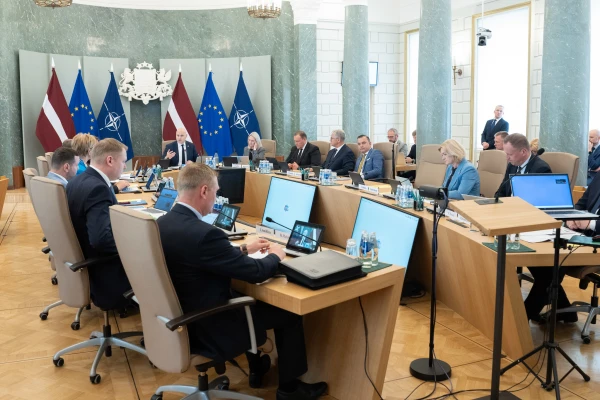
What can the Latvian authorities do to help their residents? Let’s be realistic: no fuel subsidies are expected — the government simply does not have the funds for that. It is unlikely that we can expect a repeat of "helicopter money" — that is, one-time payments to pensioners. There are even fewer funds for that. The most we are promised by the Prime Minister for now is to "monitor the situation with prices."
In other words, there is no money, but hang in there, and we will watch all this with interest!


Leave a comment