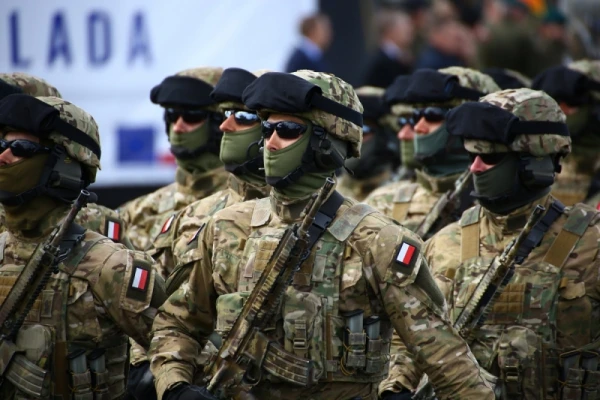
Warsaw has announced a large-scale defense reform - the "Army 500" project, which involves forming armed forces numbering 500,000, primarily through a new high-readiness reserve capable of rapid mobilization in a crisis situation.
The Essence of the Initiative
Poland's Minister of National Defense and Deputy Prime Minister, Mariusz Błaszczak, emphasized at a press conference at the General Staff that the "Army 500" project combines the professional army, Territorial Defense Forces, and a new high-readiness reserve. Through this reserve - voluntary and open to both men and women - Poland is expected to gather half a million trained and combat-ready individuals if necessary. This is reported by Euronews.
"The year 2026 will be a year of reserves for all of us, a year of reservists, a year of changes in reserves. Our ambition is an army of 500,000 people, with a large portion being those who will be in the highest state of readiness reserve. When we mention the formula "Army 500", we are talking about the potential of a professional army of 300,000 (the regular army that will always be in full combat readiness) and another group of hundreds of thousands who will be combat-ready as reservists. To varying degrees of readiness - because we have both active and passive reserves - and the reserve in this active - so-called high - readiness will conduct exercises more frequently, will be more beneficial, but will also send a strong signal to those who might threaten our security," stated the head of the Ministry of Defense during the conference.
New Reserve and the "wGotness" Program
In March, the next large-scale program of general defense training "wGotness" will be launched to prepare more participants for service in the reserve. This is a continuation of a pilot program in which over 16,000 people were already trained in 2025.
The center of the strategy will be the so-called "high readiness reserve" - a formula designed to combine elements of regular training with flexible forms of service. Reservists will train regularly, but on a voluntary basis; they will be paid for participating in exercises, will be able to attend courses and training, and will also choose a convenient training date and the unit in which they will serve.
General Wiesław Kukuła, Chief of the General Staff of the Land Forces, also noted that training will be conducted with the needs of reserve soldiers in mind. Each reservist will be required to undergo at least 8 training days per year, as well as a so-called mobilization check - a readiness check to ensure that in the event of a call-up, they can quickly arrive at the unit with the necessary equipment.
Officer Cadet Schools for the Reserve
The Ministry also plans to create so-called officer cadet schools for the reserve, which will allow individuals not professionally associated with the army to receive the appropriate training and the rank of second lieutenant in the reserve. The training process for a reserve officer is expected to last 3 years and include at least 139 training days, including basic and officer training.
According to the Ministry of Defense, participation in the reserve should combine prestige and tangible benefits while providing space for acquiring new competencies and development.
"Army 500": About 40,000 Poles to be Trained in 2026
"Army 500" is an ambitious attempt to restructure Poland's defense architecture to meet new geopolitical realities: the combination of a large professional army and a flexible, paid high-readiness reserve should increase the speed and scale of mobilization. Success depends on funding, quality of training, public support, and coordination with allies.
This is the first such large-scale initiative in Poland that allows all adults to acquire practical skills necessary in emergencies. As stated at the conference by the Secretary of State at the Ministry of Defense, Cezary Tomczyk, the goal of the program is to permanently integrate General Voluntary Defense Training into the state security system, which will be conducted annually and systematically strengthen Poland's defense potential.
"These trainings will continue throughout the year and will conclude on November 21. We want to increase the number of those who can undergo training this year. Regarding individual training, we estimate that about 30,000 adult citizens will participate. As for group training, we anticipate that around 40,000 Poles will be trained. (...) From our perspective, the most important thing is to instill in every citizen of Poland and every Polish woman a real sense of independence and self-confidence in crisis situations. This is very important from the state's point of view."
The Ministry has developed a free app called "Readiness," which complements the mCitizen app. It offers a complete package of informational and educational materials. Here you will find so-called digital defense knowledge - that is, knowledge about the security and resilience of the state.
Strategic and Demographic Challenges
According to Błaszczak, demographic changes in Poland mean that traditional conscription is insufficient to maintain the country's defense potential. Hence the idea that the majority of the armed forces should consist of trained reservists ready for rapid mobilization.
Some experts note that this model aligns with modern trends in NATO, where countries are trying to combine professional standing forces with flexible reserve structures. Others point out that funding and logistical support for such a large army remains a complex challenge, especially in the context of intensive technical modernization.
Warsaw's decision to increase its defense potential fits into the broader context of rising tensions in relations with Russia and instability in the Eastern European region. Poland is consistently increasing defense spending and developing cooperation with its NATO allies, aiming to strengthen deterrence capabilities.
The concept of "Army 500" is intended not only to strengthen self-defense but also to send a strategic signal to potential adversaries that Poland is ready and capable of mobilizing significant forces in a short time.