83,000 people cannot vote for the president of the country that governs them.
More than 100 years ago, Washington secured the sale of a group of islands in the Caribbean Sea from Denmark — very far from Greenland with its Arctic cold.
This is the story of how the Danish West Indies became the U.S. Virgin Islands and how a weakening European power ceded part of its overseas possessions to a young country that was just becoming a superpower.
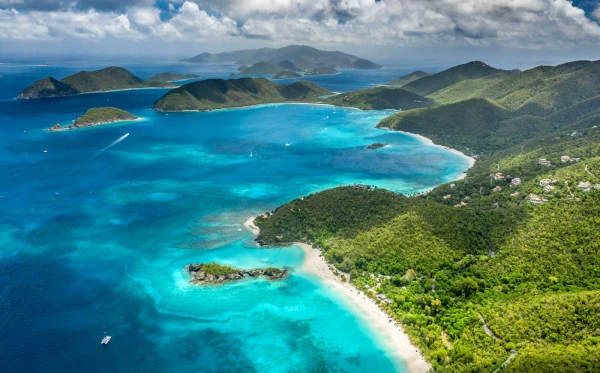
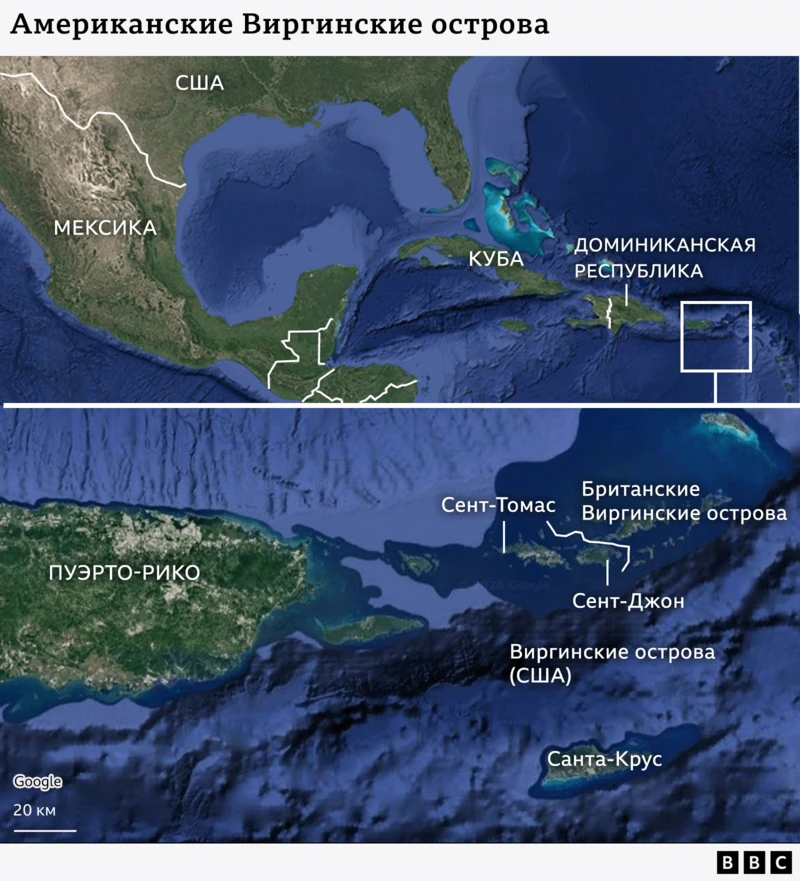
The U.S. Virgin Islands is a group of islands in the Caribbean Sea that has the status of an unincorporated territory of the United States. Nearby are the British Virgin Islands, part of the same archipelago, and to the west is Puerto Rico.
With a population of 83,000 people, this territory consists of three main islands, St. Thomas, St. John, and St. Croix, and more than 40 small islets and cays.
Although most residents of the islands are U.S. citizens, this territory is not fully integrated into the American political and legal system. Its residents cannot vote in presidential elections unless they move to one of the states, and only certain provisions of the U.S. Constitution apply to them.
The majority of the island's population are descendants of Africans who were forcibly brought to the region to work on sugar plantations during the transatlantic slave trade.
For centuries, the islands were a Danish colony and were known as the Danish West Indies.
In the 16th and 17th centuries, Spain, England, France, and the Netherlands periodically contested control over the islands — a region that often served as a haven for Caribbean pirates.
In 1684, Denmark established control over the island of St. John and declared its sovereignty over it. Shortly before that, it had done the same with the island of St. Thomas.
Denmark then began to develop large sugar plantations on the islands, which used the slave labor of Africans brought there by European traders.
In the second half of the 19th century, the situation began to change. Denmark's influence on the world stage was waning, while the U.S. had strengthened after the Civil War.
The administration of then-President Andrew Johnson sought to expand U.S. influence while simultaneously shedding European influence on the continent. Secretary of State William Henry Seward, who was planning for peaceful territorial expansion, turned his attention to the Danish West Indies. American strategists were particularly interested in the port on the island of St. Thomas — partly because its harbor could serve as an ideal base for controlling the Caribbean region.
At that time, sugar prices were falling, and Denmark was increasingly contemplating that the islands brought more problems than benefits.
The governments of the two countries negotiated the sale of the islands, and in 1867 a treaty was signed under which the U.S. was to acquire the islands for gold in the amount of $7.5 million, equivalent to about $164 million in today’s prices.
However, that deal was never realized.
Just a year later, the U.S. purchased Alaska from the Russian Empire for about seven million dollars. Seward's decision was risky and drew criticism and even ridicule: many believed it was a piece of frozen land with no economic or strategic value.
The controversies surrounding the purchase of Alaska ultimately led to Congress not ratifying the treaty for the purchase of the Danish West Indies.
The issue of the purchase was not revisited for nearly half a century. Only after the start of World War I and amid the growing threat of Germany seizing strategically located islands did the balance of opinion finally tilt in favor of America purchasing the islands.
Europe was drained by a protracted trench war, and the Allies were desperately trying to persuade the U.S. to enter the war on their side.
The U.S. initially maintained neutrality, but public discontent was growing over German submarine attacks on American merchant and passenger ships.
In 1915, the German submarine U-20 attacked the British passenger liner Lusitania off the coast of Ireland. About 1,200 people died. This turned public opinion in many countries against Germany.
Denmark also maintained neutrality. According to Astrid Andersen, a senior researcher at the Danish Institute for International Studies, "Washington feared that Germany might invade the country and take control of the islands and the port of St. Thomas." This island could become an ideal base for German submarines and be used for attacks on ships and even on U.S. territory.
In 1914, after many years of construction, the Panama Canal was opened to shipping, which also heightened U.S. interest in the region, as control over the islands would help ensure the safety of hundreds of ships passing through the sea routes each year.
Considering both economic and military factors, Washington and Copenhagen resumed negotiations.
According to Andersen, the U.S. position at that time resembles the stance currently taken by President Trump.
"In what we hear now, there are echoes of the past, because the United States back then was essentially saying, 'Either you sell this to us, or we invade,'" Andersen says.
According to information on the U.S. State Department's website, Secretary of State for President Woodrow Wilson sent Denmark a warning: if it refused to sell this territory, the U.S. could occupy the islands to prevent their possible seizure.
Compare: in early January 2026, Trump told reporters in Washington that the U.S. needed to "own" Greenland so that it would not be taken over by Russia and China, adding that he intended to achieve this "by fair means or foul."
In August 1916, Denmark and the U.S. agreed to sell the islands for $25 million in gold, equivalent to about $630 million in today’s prices, according to Bloomberg data. As part of the agreement, the U.S. committed not to oppose Denmark "expanding its political and economic interests over the entire territory of Greenland."
This time, the convention was ratified by both countries. It was also supported by the Danish people: in a referendum, an overwhelming majority voted in favor of the sale.
In reality, as Andersen notes, "most Danes did not perceive these islands as part of Denmark." As the historian points out, the population of the islands themselves was not given the opportunity to express their views on territorial belonging either during the first or the second attempt to sell the islands.
But now the problem is that Denmark is not planning to sell Greenland.