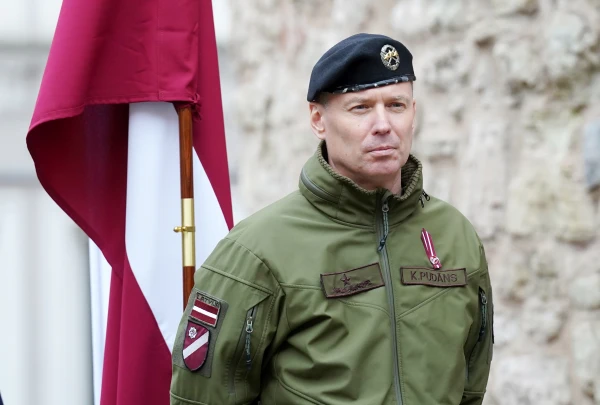
Currently, the military threat from Russia to NATO in the coming years is unlikely; however, much will depend on the events of this year in Ukraine, stated the commander of the National Armed Forces (NBS) Kaspars Pudiņš in an interview with the LETA agency.
Commenting on statements from several Western officials regarding the alleged timelines for a possible Russian attack on NATO, Pudiņš noted that he would not assess the likelihood of an attack in any specific year, as theoretically, an attack could happen even today.
According to him, when comparing the military capabilities of the aggressor state Russia, it cannot be said that they have significantly changed compared to last year. Russian soldiers continue to die in the war in Ukraine, and all restored forces are essentially being sent back to the front.
Pudiņš emphasized that it is also important to consider what goals Russia is pursuing. The West, including the Baltic states, has been on the list of "enemies to be punished" for many years.
Looking to the future, much will depend on what happens in Ukraine this year. A pause or decrease in hostilities would allow Russia to concentrate its forces more quickly, including through possible new large-scale mobilizations and the withdrawal of soldiers participating in the war in Ukraine.
Russia is also observing the actions of the West, which, according to Pudiņš, has become much stronger and more united in both military and various political aspects.
"We have reached a level where we can make joint decisions. They (Russia) also see the set goals in the field of rearmament and military industry development, and if countries adhere to them, it will reduce risks. That is why years like 2028, 2029, 2030, and even up to 2037 are mentioned, because parity may be achieved then, especially in the military industry," Pudiņš emphasized.
Considering this, the army commander believes that in the coming years, the external military risk for NATO is unlikely, as Russia is unlikely to be able to implement such a scenario.
At the same time, there are other possibilities that Russia is likely to use to achieve its goals.
Pudiņš pointed to Russia's hybrid operations or even possible military actions that may be disguised and not appear as an attack on NATO territory or as a direct invasion for the purpose of occupation.
"The goal is for us to start thinking: no, we need to arm ourselves more, which we are actually doing, and to divert our attention from Ukraine. This has been going on for almost the entire period of the war, but it has not yielded results," Pudiņš believes.
He added that even if the war stops and a ceasefire is reached, whatever Russia tells its society and the rest of the world about achieved goals and "victories," the greatest danger lies in the fact that the dictator Vladimir Putin will still have a desire for revenge. Understanding that Russia has suffered for several years, endured losses, and will go down in history with such a burden, Putin may want to achieve some "brilliant victory," noted the head of the National Armed Forces.
"This is a potential risk. But are there necessary grounds for this? At the moment, there are none," Pudiņš concluded.