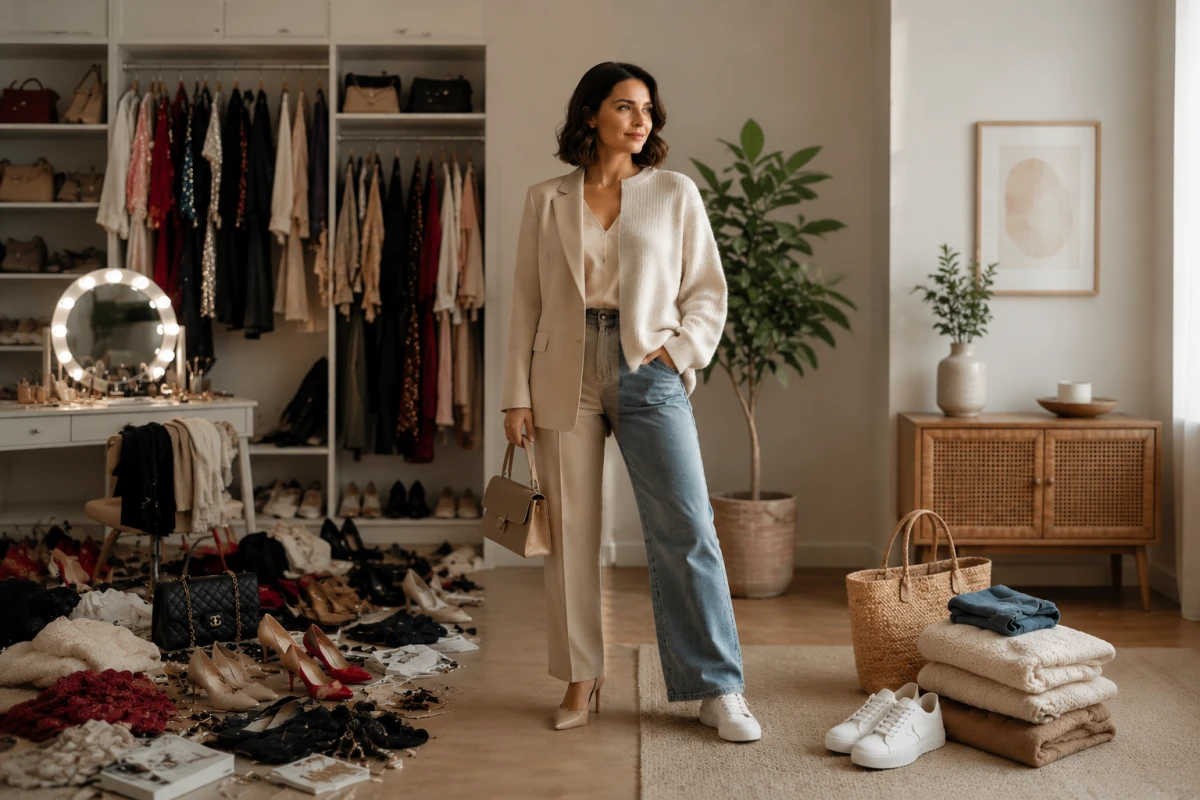
Style is not just about fashionable items, but also about the feeling of oneself in clothing. When a person dresses for impression, they lose freedom and naturalness. Learning to dress for oneself means finding harmony between appearance and inner state, feeling confidence and comfort.
Most people think that style is only about clothing. But very often, it hides something else: the desire to please, to conform, to make the right impression, to look "good enough" in the eyes of others.
And there is nothing strange about this. We grow up in a world where appearance is constantly evaluated. From childhood, we absorb the idea that clothing can make us better, more interesting, more successful, more feminine, more expensive.
Gradually, style stops being a way to express oneself and becomes a way to manage others' perceptions. This is why so many people, even with a full wardrobe, feel a strange disconnection from themselves. The clothes can be beautiful, fashionable, expensive, but inside there is no feeling of alignment.
Why We Start Dressing for Impressions
The desire to please is natural. The problem begins when it becomes the main guideline. Then the choice of clothing gradually stops being centered around the question, "Do I look good in this?".
And it starts to revolve around another:
-
How does it look from the outside?
-
Is it beautiful enough?
-
What will others think of me?
-
Is it too simple?
-
Is it too strange?
As a result, a person can wear clothes for years that objectively suit them, but subjectively do not provide a sense of self.
This happens especially often with women because women's appearance is constantly evaluated — by society, social media, the beauty industry, even random comments from others.
And unnoticed, the habit of looking at oneself through others' eyes appears.
What Style "for Impressions" Looks Like
Sometimes it manifests as overly complicated outfits, where effort is palpable. Sometimes it’s a constant striving to look expensive, perfect, feminine, or fashionable, even if it doesn’t match the inner state.
And sometimes, on the contrary, a person is so afraid of standing out that they start dressing as safely and neutrally as possible, just to avoid reactions.
But almost always, there is one common sign: it is hard to relax in such clothing.
You constantly check yourself:
-
Does the garment fit well;
-
Does anything look "off";
-
Am I impressive enough;
-
Does the look match the situation.
And energy is spent not on living, but on constant internal control.
Why This is More Exhausting Than It Seems
When appearance becomes a way to earn approval, you almost never feel at peace. Even beautiful clothing starts to be perceived as something that needs constant monitoring.
From this comes stiffness in movements, the habit of constantly adjusting clothes, tension in the face and body, a feeling that you need to conform to an image.
This is why sometimes a woman in the simplest outfit looks freer and more interesting than one whose look is perfectly put together but is held together by internal tension.
People read not just clothing. They read the state within it.
Style "for Yourself" Does Not Mean a Lack of Taste
It is very important to understand: dressing for yourself does not mean stopping to care about appearance or completely ignoring aesthetics. It does not mean that you don’t care how you look.
On the contrary, often it is only after giving up the constant desire to impress that style becomes deeper, more precise, and more interesting.
Because the main guideline emerges — your own feeling. You start to notice which clothes make you feel calm, in what you move naturally, which colors are truly yours, and which silhouettes make you feel more confident rather than stiff and constrained.
Why Many Are Afraid to Dress for Themselves
Because it requires honesty. When the desire to please everyone disappears, you have to ask yourself more complex questions:
-
What do I actually like?
-
Who do I want to be?
-
What am I trying to hide behind my clothing?
-
Where is my taste, and where is the desire to conform?
And sometimes the answers turn out to be unexpected. For example, a woman wears only "feminine" clothes for years because she believes that is how she looks attractive. Although in reality, she is closer to minimalism, relaxed silhouettes, and simplicity.
Or, on the contrary, she hides in basics and neutrality, not because she loves it, but because she fears attention.
Style "for yourself" almost always begins at the moment when you stop automatically choosing what should make the right impression.
How to Understand That a Garment is Truly Yours
There is a very simple but honest criterion: your body reacts before your mind.
When a piece truly aligns with you, it is easier to move in it, and you don’t feel the need to constantly check yourself. The feeling of "playing a role" disappears, and relaxation appears.
Sometimes it is hard to notice immediately because many are used to focusing only on the external effect. But the body almost never lies.
If a piece is beautiful, but you feel the need to constantly suck in your stomach, control your posture, or "conform," then it is likely clothing for impressions, not for you.
Why Simplicity Often Looks Stronger
When a person stops trying to seem like someone else, their appearance becomes calmer, which is why it often looks stronger.
Overload and unnecessary effort disappear. A sense of wholeness appears. This is why some people look stylish even in the most basic items.
Because they do not "wear an image" separately from themselves. The clothing does not argue with the person but continues them.
Social Media and Other People's Style as a Trap
Today, it is very easy to lose touch with your taste because we are constantly looking at others'. Social media creates an endless stream of images, and gradually it begins to seem that style is a set of visually correct pictures.
But the problem is that someone else's style works in the context of someone else's appearance, physique, character, and life. You can completely replicate an image but still feel alien in it.
Therefore, it is important not only to be inspired but also to constantly redirect attention to yourself by asking questions:
-
Do I really like this?
-
Do I like how this looks on others?
-
Do I want to live like this or just look like it?
These are very different things.
Learning to Dress for Yourself
Many women choose clothing to please others: a bright jacket, expensive shoes, a carefully assembled look. But sometimes the simplest outfit — jeans, a white t-shirt, and a soft cardigan — looks much more impressive if you feel free in it.
For example, Marina, 52, wore only strictly feminine dresses all her life, thinking that this is how she looks more attractive. When she started experimenting with minimalism — loose pants, cozy sweaters, sneakers — colleagues and friends noted that she began to look younger, and most importantly, she felt joy in movement and confidence.
Or another example: Elena, 47, always tried to look expensive and fashionable by buying the latest trends. Inside, she felt tension: constantly adjusting her clothes, checking how the dress fit. After she began to choose items based on comfort and her own taste rather than trends, her look became harmonious, natural, and "fresh" — without unnecessary effort.
The main guideline is your own body. If in clothing you feel the need to suck in your stomach, control your posture, or constantly check your look in the mirror, then it is not your style. When clothing aligns with you, movements are relaxed, smiles are natural, and the image is perceived as whole.
Social media and other people's images can be inspiring, but true style is formed from within. It starts with the permission to be yourself, not with imitating someone else. A woman who dresses for herself can look impressive even in a basic outfit — jeans, a sweater, sneakers — simply because the clothing "continues" her personality rather than distracts from it.
Simple, comfortable, and thoughtful items chosen with respect for oneself create the effect of true style that cannot be faked.