Summer is the time for bright colors in the garden, but by mid-season, many flower beds lose their impressive appearance. There are plants that please the eye for months without requiring constant watering and care. These 7 perennials will help create a colorful and low-maintenance flower bed.
Anyone who has ever planted a flower bed knows this pain: in June, everything is drowning in colors, but by mid-August, the flower bed looks dreary — the peonies have faded, the irises have burned out, and all that remains is withered foliage. But there are plants that can bloom for months without requiring any fuss. Here are seven perennials that will turn your garden into a continuous celebration of color.
Horned Violet, Which Is Undeservedly Ignored
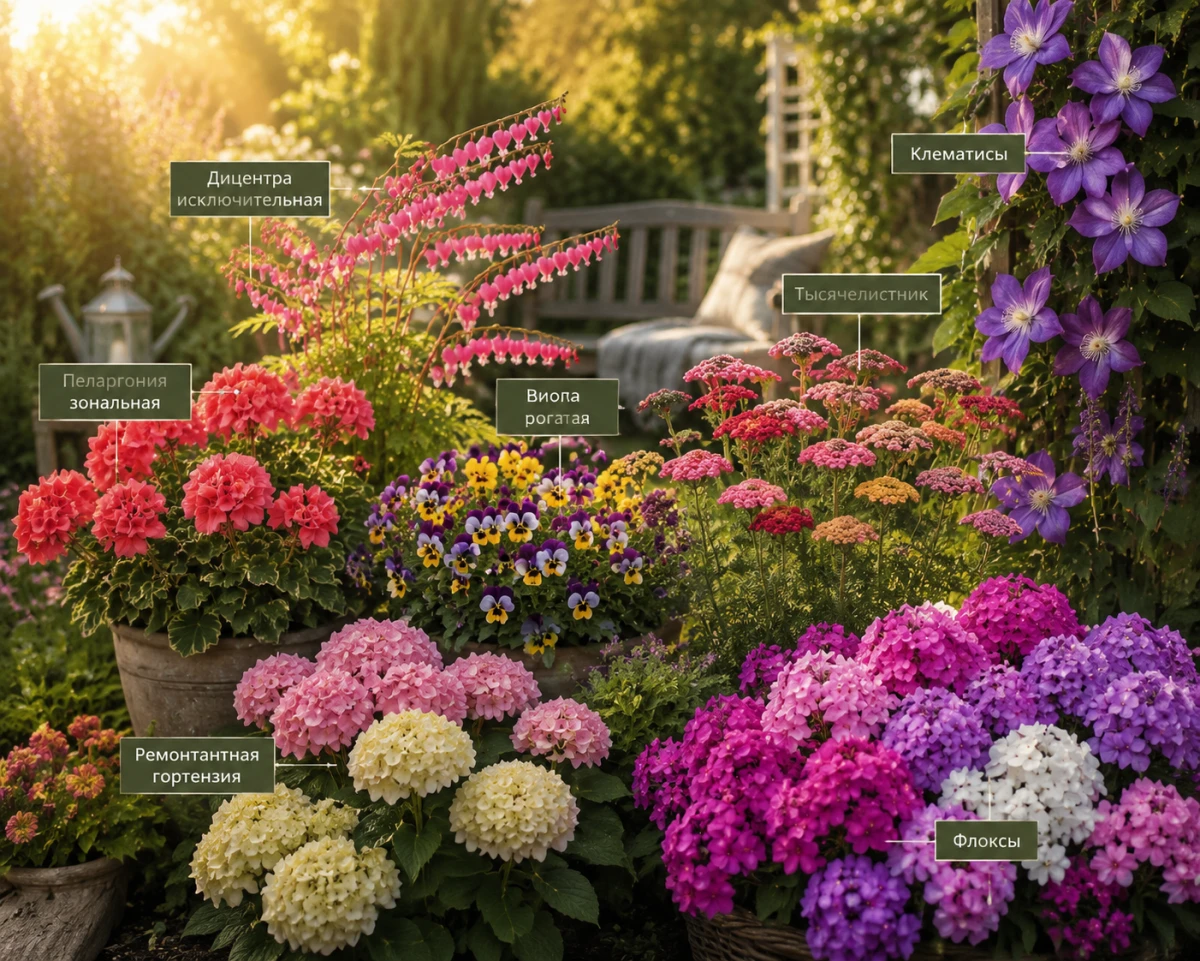
Everyone knows the common violet, but its "horned" relative is often overlooked. This plant forms compact bushes up to 20 cm tall, literally covered in flowers. The secret is that up to 60 (!) flowers can bloom simultaneously on one bush. The horned violet blooms from May to September, winters well, and requires no complicated care. It is best to plant it in partial shade — it does not thrive as well in scorching sun.
Exceptional Dicentra — Not the One with the "Broken Heart"
Many know dicentra as a spring plant with flowers shaped like a broken heart, which fades and disappears by June. But exceptional dicentra works differently. Its delicate lace-like leaves sprout as early as April, and it blooms... all summer long! Pink or purple "hearts" adorn the garden continuously, and by the end of the season, there can be a second wave of blooming. The plant reaches 30–50 cm in height and thrives both in sun and partial shade.
Zonal Pelargonium — The Queen of Containers
This beauty is commonly seen on windowsills, but its true calling is the garden. Modern varieties grow beautifully in pots, hanging baskets, and containers, delighting with blooms from May to October. Pelargonium does not stretch, maintains a neat shape, and continues to bloom actively even in the heat. The only thing it does not like is standing water.
Yarrow, Which Is No Longer a "Grandmother's Flower"
Forget about the modest white "daisies" by the roadside. Decorative varieties of yarrow are a riot of colors: raspberry, yellow, pink, and orange flower clusters. And it blooms from June to September! The main advantage of yarrow is its resilience. It does not care about heat and drought, grows in any well-drained soil, and does not get sick. It blooms especially profusely in the sun.
Clematis — A Double Blooming Hit
Many consider clematis to be capricious day-bloomers. But that's a mistake! First and second pruning group varieties can bloom twice in a season: first on last year's shoots, and then, closer to autumn, again. As a result, arches, pergolas, and fences remain decorated for several months in a row.
remontant Hydrangea — A Lifesaver for Cold Regions
Large-leaf hydrangeas are known for their capriciousness — they freeze, do not bloom, and sulk. But remontant varieties have changed the game. Their secret is that flower buds are formed not only on old but also on new shoots of the current year. This means that even if the bush freezes in winter, it will still bloom in summer, producing new shoots from the root. Essentially, this is a "hydrangea with a safety net."
Phlox — A Trick for the Second Wave
Phloxes bloom lushly and fragrantly from July to August. But what if you want to extend this celebration until September? Experienced gardeners know the secret: after the first wave of blooming ends, you need to cut back the faded flower clusters — about the "top" of the stem. This stimulates the growth of side shoots, which will bloom again. The second wave will not be as lush as the first, but it will delight you when most flowers have already faded.
A beautiful and lush garden without endless effort is a reality. Horned violet, exceptional dicentra, pelargonium, decorative yarrow, clematis, remontant hydrangea, and phloxes will ensure continuous blooming all summer long. Just plant them once and enjoy the flowers, knowing they can handle the heat, sun, and infrequent watering.