
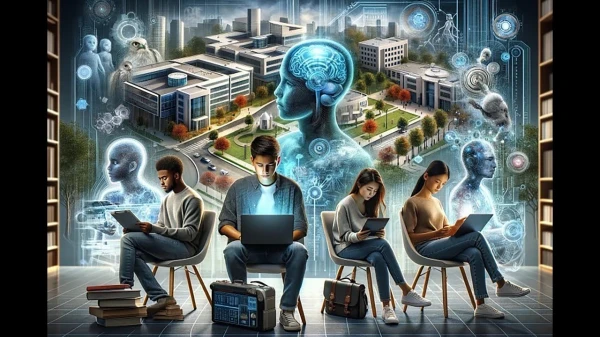
Artificial intelligence is increasingly perceived as a tool that should free humans from routine and reduce working hours. However, in practice, the effect turns out to be the opposite: instead of alleviating the load, employees begin to work more and harder.
How AI Changes the Work Rhythm
Research shows that the implementation of AI does not reduce the volume of tasks; on the contrary, it increases it. Even in the absence of pressure from management, employees begin to do more work and stay connected longer.
One reason is the changing approach to tasks. People are more likely to take on additional responsibilities that they could previously postpone or delegate. The acceleration of processes creates a sense that more can be accomplished, and this gradually becomes the new norm.
Increase in Multitasking and Workload
AI sets a different pace of work: employees manage several processes at once, switch between tasks, and interact with multiple tools simultaneously.
This increases cognitive load. Despite the apparent efficiency, constant attention switching leads to fatigue and decreased concentration.
Expansion of Responsibilities
With the advent of AI, employees begin to perform tasks that were previously outside their competencies. Technology allows for quick mastery of new areas, but with this comes an increase in responsibility.
As a result, work becomes not only greater in quantity but also more complex in content.
Time for Verification
Another factor is the need for oversight. Results generated by AI require additional verification and correction.
This takes up a significant portion of the time that was supposedly freed up by automation.
Blurring of Work Boundaries
AI makes the work process almost imperceptible: interaction with it resembles regular correspondence.
Because of this, employees continue to perform tasks outside of working hours—during breaks, in the evening, or even at night. The boundaries between work and rest become less distinct.
Why This Becomes a Problem
At first glance, increased productivity seems beneficial. But behind this lies a rise in tension and fatigue.
Constant multitasking, the need for oversight, and an increase in task volume lead to the risk of burnout. Meanwhile, expectations of employees grow, and the feeling of overload intensifies.
How to Reduce the Load
To avoid falling into the trap of endless busyness, it is important to consciously structure work with AI.
It is helpful to take regular breaks to reduce tension and assess progress. Equally important is to complete tasks sequentially rather than trying to manage several processes simultaneously.
Additionally, face-to-face communication with colleagues helps maintain balance and prevents work from becoming a continuous flow of interaction with technology.
Artificial intelligence can indeed enhance efficiency, but without clear boundaries and rules, it easily turns into a tool that increases the load instead of reducing it.
















Leave a comment