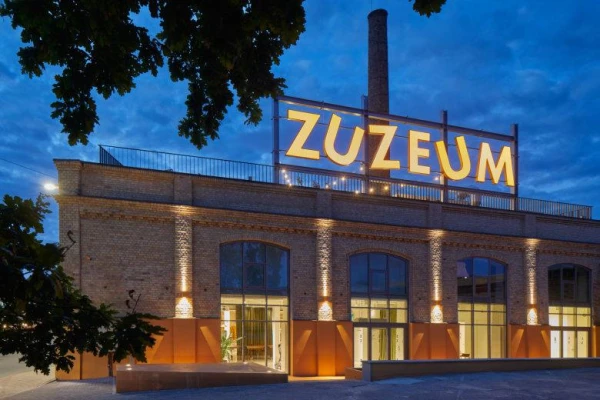
The Zuzeum Art Museum opened the autumn season with an exhibition in the Great Hall—"The Whole World is Bauhaus," dedicated to the legacy of the legendary German architectural and artistic school Bauhaus.
Until December 28, visitors can embark on an exciting journey through the history of modernism and discover new facets of the school that had a tremendous impact on 20th-century culture and art.
The traveling exhibition "The Whole World is Bauhaus" has been touring the world since 2019. Until now, it has only been shown in Germany and Poland, making its arrival in Riga a truly unique event for audiences in the Baltic countries.
The title of the exhibition resonates with its format: moving from country to country, the exhibition forms new global connections and allows for a look at the role of modernism from different geographical perspectives, where this artistic movement continues to serve as a source of inspiration and rethinking.
In its time, Bauhaus became both a celebrated and controversial symbol of modern design and an avant-garde approach to understanding life. Despite its short existence—from 1919 to 1933 in Weimar, Dessau, and Berlin—the school became a catalyst for the progressive spirit of modernism, uniting art, craft, and industrial production, and then spreading these ideas around the world.
How could Bauhaus, which graduated only about 1,300 students, exert such a strong influence and become a source of radical change in design, pedagogy, and social spheres? What makes its legacy so unique and relevant today?
The title of the exhibition "The Whole World is Bauhaus" refers to a quote from student and teacher Fritz Kura (1928). This formula alludes to the idea proclaimed by Walter Gropius: the task of design is to encompass not only all areas of design but also social practice in its broadest sense.
The exhibition explores the phenomenon of the famous school through eight thematic sections covering the period from 1919 to 1933. Key themes include experimental use of materials, integration of art and life, innovative pedagogical approaches, as well as the political and social ideals of the school. Special attention is given to the everyday lives of students and teachers, and the international connections of Bauhaus—from interactions with Vkhutemas in Moscow to its influence in the USA.
Bauhaus was able to respond to the challenges of rapid industrialization in Germany and lay the foundations of modern design and architecture. Many of its teachers—influential modernist artists—spread the ideas of the school far beyond Europe after emigrating.
The exhibition brings together unique photographs, documents, graphics, films, texts, and objects that allow for a deeper understanding not only of the history of Bauhaus but also of the essence of modernism.