Particularly little is known about the earliest 'building blocks'.
Earth may have received crucial ingredients for the emergence of life much earlier than previously thought. The authors of a new study showed that the primary sources of phosphorus and nitrogen — two essential components of living systems — may not have been late meteorites from the outer part of the Solar System, but rather the very first planetesimals that formed near the young Sun.
The question of the origin of vital elements on Earth is one of the central themes in planetary science. It was traditionally believed that a significant portion of volatile substances and other necessary components for life came to our planet through carbonaceous chondrites — ancient meteorites from the outer part of the Solar System.
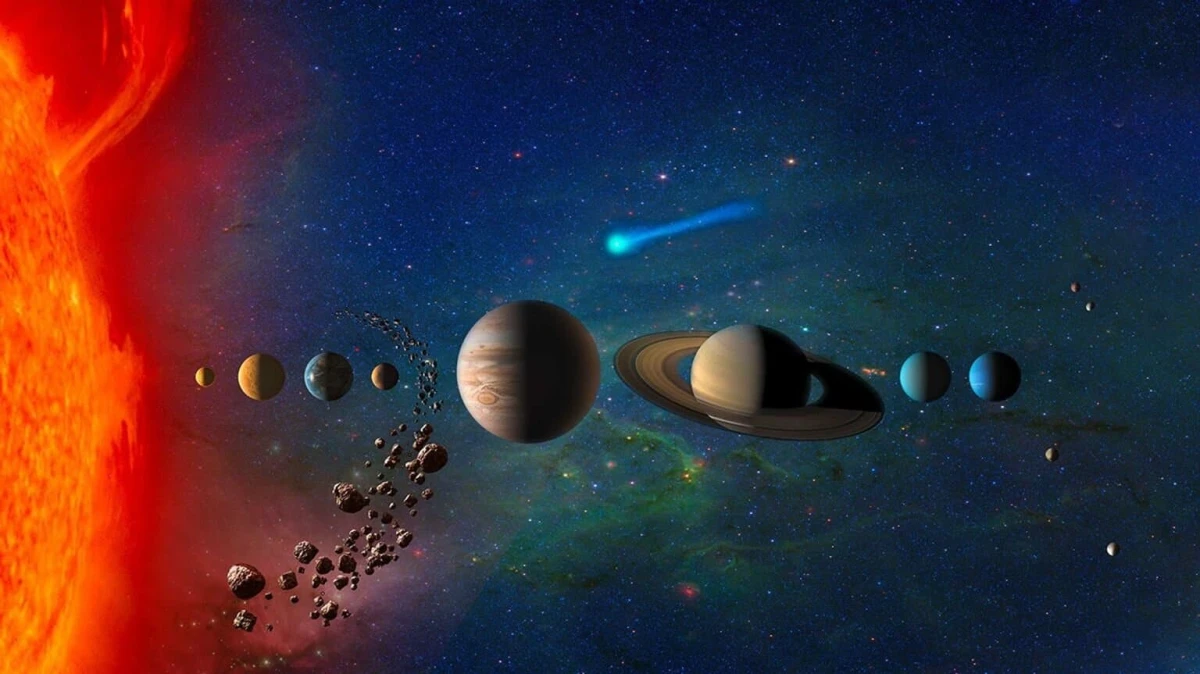
However, recent data have shown that this picture may be overly simplistic. Earth formed from many generations of planetesimals, and the contributions of various sources changed over millions of years. Particularly little is known about the earliest building blocks of planets that emerged less than a million years after the birth of our star system. Today, they are mostly represented by iron meteorites — remnants of the metallic cores of destroyed protoplanetary bodies.
By tracing the history of two elements — phosphorus and nitrogen — researchers were able to learn more about the regions where ancient planetesimals formed. These elements were chosen for a reason: nitrogen is a component of proteins and nucleic acids, while phosphorus is a crucial part of DNA, RNA, and molecules responsible for energy transfer in cells. Nitrogen easily evaporates and is classified as a volatile element, while phosphorus condenses at much higher temperatures.
To model the processes occurring within the early metallic bodies of the Solar System, the authors of the scientific paper published in the journal Science Advances conducted a series of high-temperature experiments. In the laboratory, they studied how phosphorus and nitrogen are distributed between solid and molten iron-nickel alloys. The obtained data were then used to reconstruct the composition of the parent bodies of iron meteorites.
It turned out that the earliest planetesimals in the outer part of the Solar System contained more phosphorus relative to nitrogen than similar objects in the inner region. However, for later bodies — chondrites — the picture was the opposite: their representatives from the outer region of the system had lower values of this ratio. This means that within just the first few million years, the chemical structure of the protoplanetary disk changed significantly.
The researchers hypothesized that in the early stages of our star system's existence, the inner regions of the disk were very hot and turbulent. It was there that the phosphorus-rich mineral schreibersite was actively forming. Streams of material carried these particles outward to the cooler regions, where the first planetesimals of the outer part of the system formed. Later, turbulence weakened, and the growing Jupiter hindered the transfer of material between the inner and outer regions. As a result, the delivery of phosphorus-rich particles decreased, and the chemical balance shifted in the opposite direction.
Then, to test which types of planetesimals could reproduce the modern ratio of phosphorus to nitrogen in the Earth's mantle, scientists modeled the formation of Earth. The calculations showed that carbonaceous chondrites from the outer part of the Solar System alone yield values that are too high. In contrast, early planetesimals from the inner part of the system much better reproduce the observed composition of Earth.
An additional argument came from isotopic data on nitrogen. If its main source were external carbonaceous bodies, the isotopic composition of the Earth's mantle would be different. Models also showed that inner planetesimals better match both the chemical and isotopic characteristics of modern Earth.
Thus, planetary scientists painted a more complex picture of the origins of the building blocks of life. Instead of a one-time delivery of vital elements from the outer part of the Solar System, Earth likely received them throughout its growth from different generations of planetesimals. Moreover, the oldest bodies from the inner region of the protoplanetary disk played a significant role — objects that existed long before the appearance of familiar meteorites.