
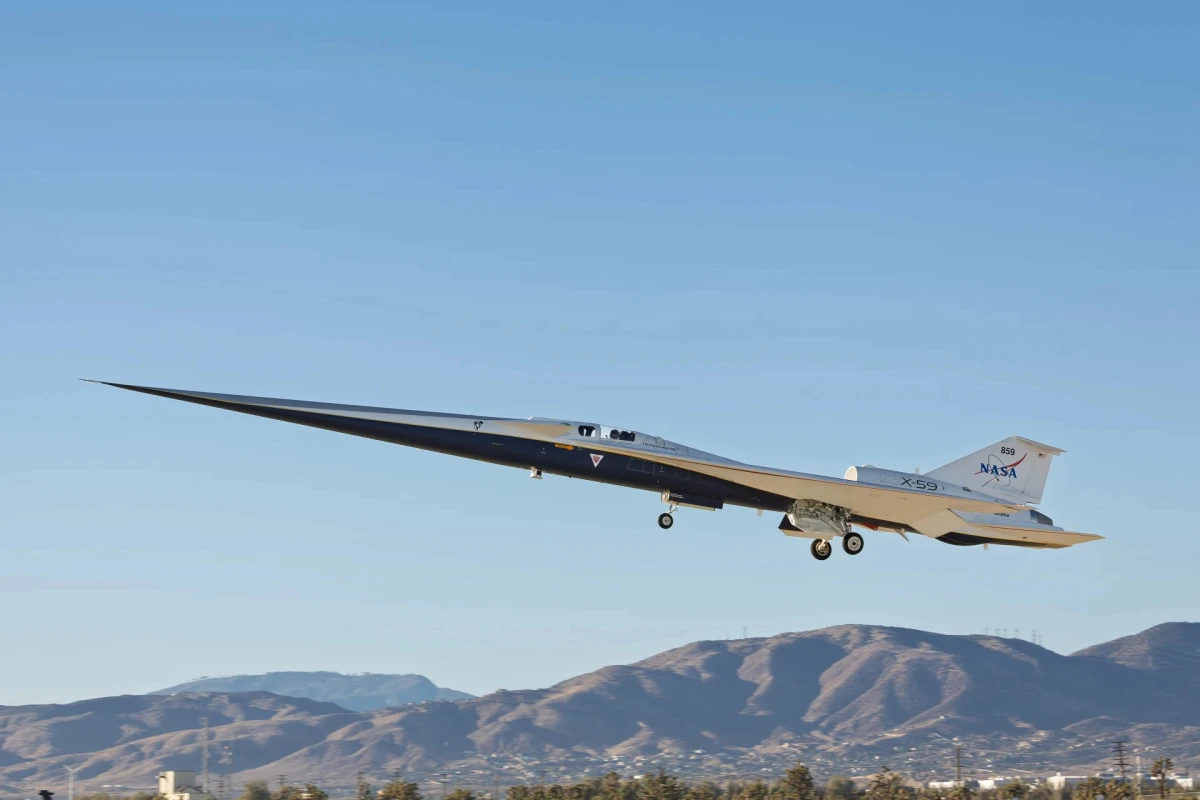
The experimental aircraft X-59 QueSST, developed by NASA in collaboration with Lockheed Martin, has for the first time exceeded the speed of sound.
During a test flight on June 5, the aircraft reached a speed of 1.1 Mach, opening a new chapter in the development of supersonic aviation. Engineers hope that the unique technology will allow for the return of passenger supersonic flights over land in the future without the deafening sonic boom, reports polsatnews.
An Important Step for the Aviation of the Future
The X-59 QueSST (Quiet SuperSonic Technology) is being developed by NASA and Lockheed Martin as part of a program to create quiet supersonic technologies.
The main feature of the aircraft is its unusual design, which significantly reduces noise levels when breaking the sound barrier. The loud sonic boom has long been the main obstacle to the development of supersonic passenger transport over densely populated areas.
During the test flight on June 5, the X-59 accelerated to a speed of about 1.1 Mach and officially broke the sound barrier. The flight lasted 81 minutes.
The First Supersonic Success
NASA called the test a major milestone for the Quesst program.
"Today, the X-59 achieved supersonic speed for the first time in its history. This is an important milestone for the NASA Quesst mission and a significant step towards future flights that will demonstrate the capabilities of quiet supersonic technology before it is used over populated areas," stated NASA Aeronautics.
According to NASA Administrator Jared Isaacman, specialists expect to conduct new tests in the coming days and increase the aircraft's speed to 1.4 Mach.
When Supersonic Flights Might Return
The next phase of the program will involve testing in conditions as close to real-world operation as possible. Engineers plan to gather data on noise perception from residents in areas over which the aircraft will fly.
If the technology proves effective, it could lead to a revision of existing restrictions on supersonic flights over land.
Today, most countries prohibit such flights due to the powerful sonic boom that occurs when breaking the sound barrier. The developers of the X-59 hope to replace it with a significantly quieter sound effect, which will be perceived more like a muffled pop.
The Return of the Supersonic Travel Era
The successful breaking of the sound barrier has been one of the most important milestones of the X-59 program. If further tests confirm the engineers' calculations, the technology could pave the way for a new generation of passenger aircraft capable of covering vast distances significantly faster than modern planes while not causing discomfort for people on the ground.













Leave a comment