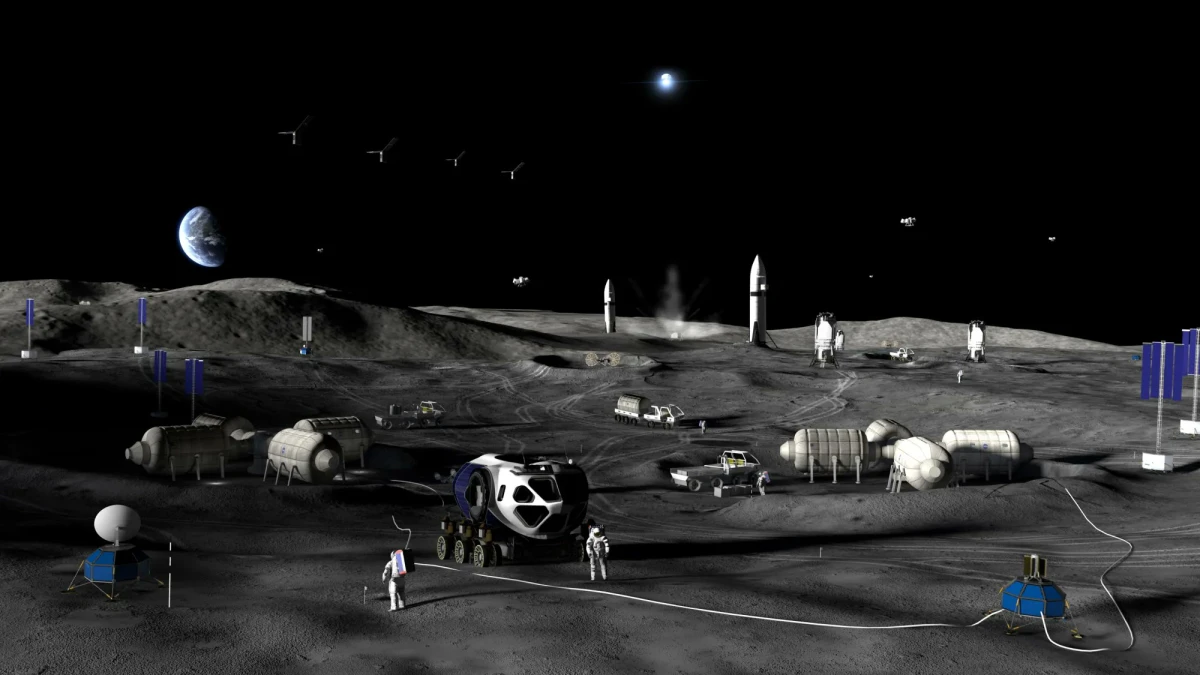
NASA has unveiled the first phase of a large-scale plan to establish a permanent base on the Moon. Before astronauts land on the satellite, rovers, drones, and construction equipment are set to be sent.
NASA is transitioning from individual lunar missions to the establishment of a full-fledged permanent base on the Moon. The agency has already signed contracts with several American companies to prepare the infrastructure for future human presence on the Earth's satellite.
The first phase of the project involves sending robots, rovers, and drones to the Moon. Jeff Bezos's company Blue Origin is set to provide the ships for transporting the equipment to the lunar south pole. Rovers are being developed by Astrolab and Lunar Outpost, while Firefly Aerospace will handle the delivery of the first unmanned aerial vehicles.
NASA hopes to send all this equipment to the Moon before the first new landing of astronauts, tentatively by 2028.
In fact, the agency wants to prepare the site for the future base in advance so that people arrive at a partially completed infrastructure. In the second phase, starting in 2029, NASA plans to begin constructing permanent infrastructure, including an energy system and elements of the lunar electrical grid. By the early 2030s, the base is expected to evolve into a fully functional long-term complex with living modules for astronauts.
This means that humanity may transition for the first time from brief visits to the Moon to a permanent presence on another celestial body.
NASA has a particular interest in the lunar south pole. It is there that scientists hope to find reserves of water ice, which could be used in the future to obtain water, oxygen, and even fuel.
The U.S. lunar program is currently viewed not only as a scientific project but also as part of a new space race. In March, NASA announced that it would invest about $20 billion in the establishment of the base while abandoning the construction of the Gateway orbital station around the Moon.
At the same time, the implementation of these plans directly depends on the development of a new spacecraft to transport people to the lunar surface. This task is being handled by Elon Musk's SpaceX, but the project is facing serious technical difficulties and delays.
Meanwhile, China is actively developing its own lunar program. Beijing plans to conduct its first crewed mission to the Moon by no later than 2030, and many experts are already calling the current situation a new version of the space race of the 21st century.
After decades of discussions about Mars, the Moon is once again becoming the main focus of global space exploration — not as a symbolic flight, but as an attempt to create humanity's first extraterrestrial base.