Such contacts can lead to serious distortions.
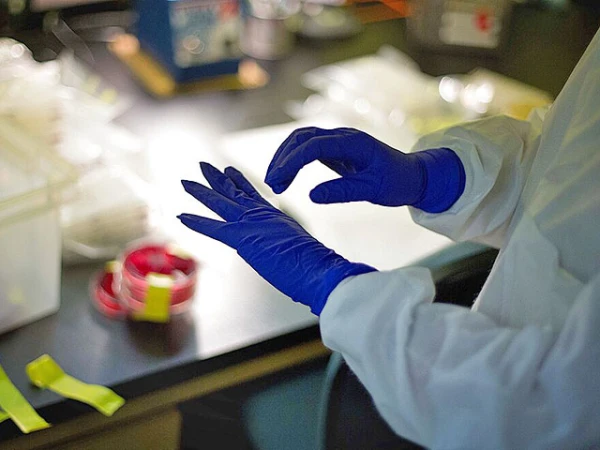
According to a study by the University of Michigan, nitrile and latex gloves used by scientists when analyzing microplastics may distort results by inflating their quantity. It was found that such gloves can inadvertently contaminate laboratory equipment with stearate particles – substances of non-plastic nature. This affects the measurements of microplastics in air, water, and other samples. Researchers recommend using special cleanroom gloves in such experiments, as they release significantly fewer particles.
Stearates are salts that resemble soap in their properties. They are applied to disposable gloves to facilitate their removal from molds during production. However, the problem is that, due to their chemical characteristics, these substances are similar to some types of microplastics, causing the equipment to mistakenly "recognize" them as plastic particles. Scientists emphasize that their findings do not mean that the problem of microplastics does not exist. Even if their quantity in several studies may be inflated, they still exist in the environment in significant amounts.
Researchers metaphorically describe their task as "searching for a needle in a haystack," although ideally, this "needle" should not exist at all. The work was published in RSC Analytical Methods and supported by a research grant from the university. The project began as part of an interdisciplinary collaboration among chemists, statisticians, and specialists in climate and aerospace engineering. Scientists studied the presence of microplastics in the atmosphere of Michigan. Special devices with a metal substrate were used for air sampling: the air passing through them left particles on the surface, which were then analyzed using light spectroscopy.
Initially, the team prepared samples in nitrile gloves, as is usually recommended. However, the results were unexpected – the level of microplastics was thousands of times higher than expected. This prompted the scientists to conduct additional experiments. They tested seven types of gloves, including nitrile, latex, and those designed for "clean rooms," as well as various methods for identifying microplastics. The experiment simulated the normal contact of a gloved hand with laboratory surfaces – for example, filters or microscope slides. It turned out that such contacts could lead to serious distortions: an average of about 2000 false signals were recorded per square millimeter. The reason was the transfer of stearates from the glove surfaces, which were then mistaken for microplastics. Meanwhile, cleanroom gloves showed the best results, as they release virtually no such particles – likely due to the absence of a stearate coating.
Additional experiments showed that distinguishing stearates from real microplastics is extremely difficult: even with scanning electron and light microscopy, they appear almost identical, for example, like polyethylene. This further complicates the accurate assessment of pollution levels.
<iframe width="560" height="315" src="https://www.youtube.com/embed/Em11NCmT7UQ?si=aXUp32FJKq_8sM-q" title="YouTube video player" frameborder="0" allow="accelerometer; autoplay; clipboard-write; encrypted-media; gyroscope; picture-in-picture; web-share" referrerpolicy="strict-origin-when-cross-origin" allowfullscreen></iframe>