
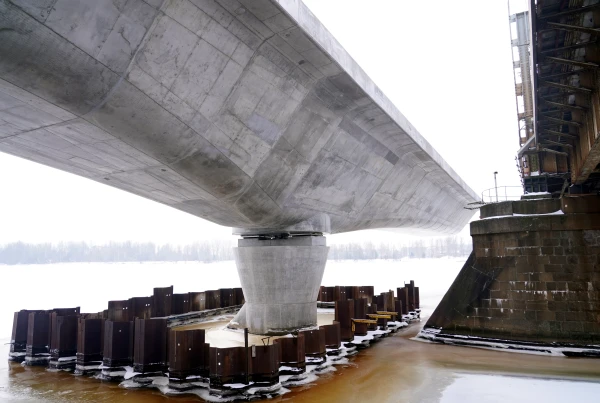
And no one knows anything. Not even the Prime Minister. How and by whose blessing was a supporting bull of the bridge installed along the Rail Baltic route in the center of Riga if no one plans to build anything there in the coming years?
Representatives of the company promoting the project are currently convincing the public that the decommissioning of the 'bull' will take place after 2030. That is, it still needs to be decommissioned now.
The Prime Minister was upset: “I believe they should be able to explain why such decisions were made, the result of which was this pile!”
As is known, for such projects, financing for such a structure must be approved at the 'highest levels' because it immediately involves costs in the millions of euros. Someone has to allocate these funds, and there must be many signatures on the conditional bill of lading. But we had no one responsible.
At the same time, the pile exists, the Central Station is in disarray, and work continued even after it became clear that there would be no loop through Riga to the airport in the first phase of construction. It was also known that the cost of the first phase of Rail Baltic in Latvia could reach 5.5 billion euros, while the entire project from Tallinn to the Polish border would cost 23.8 billion euros. For comparison, a previous cost analysis from 2017 estimated that the project as a whole would cost 5.8 billion euros.
Now we would like to understand where all these 'forecasters' from 2017 are? Do they bear any responsibility for the fact that the initial costs do not match the final ones by a factor of four? Of course not. The forecasters bear no responsibility for their predictions.
Let us remind you that the Rail Baltic project involves laying 870 kilometers of railway from Tallinn to the Polish border with a gauge of 'N' – 1435 mm. Trains are supposedly supposed to rush along it at speeds of up to 240 km/h. Meanwhile, the country currently uses a gauge of 'K' – 1524 mm. With rare exceptions – in the amusement park in Ventspils, there is gauge 'L', and on the 33-kilometer line from Aluksne to Gulbene, there is gauge 'P'.









Leave a comment