
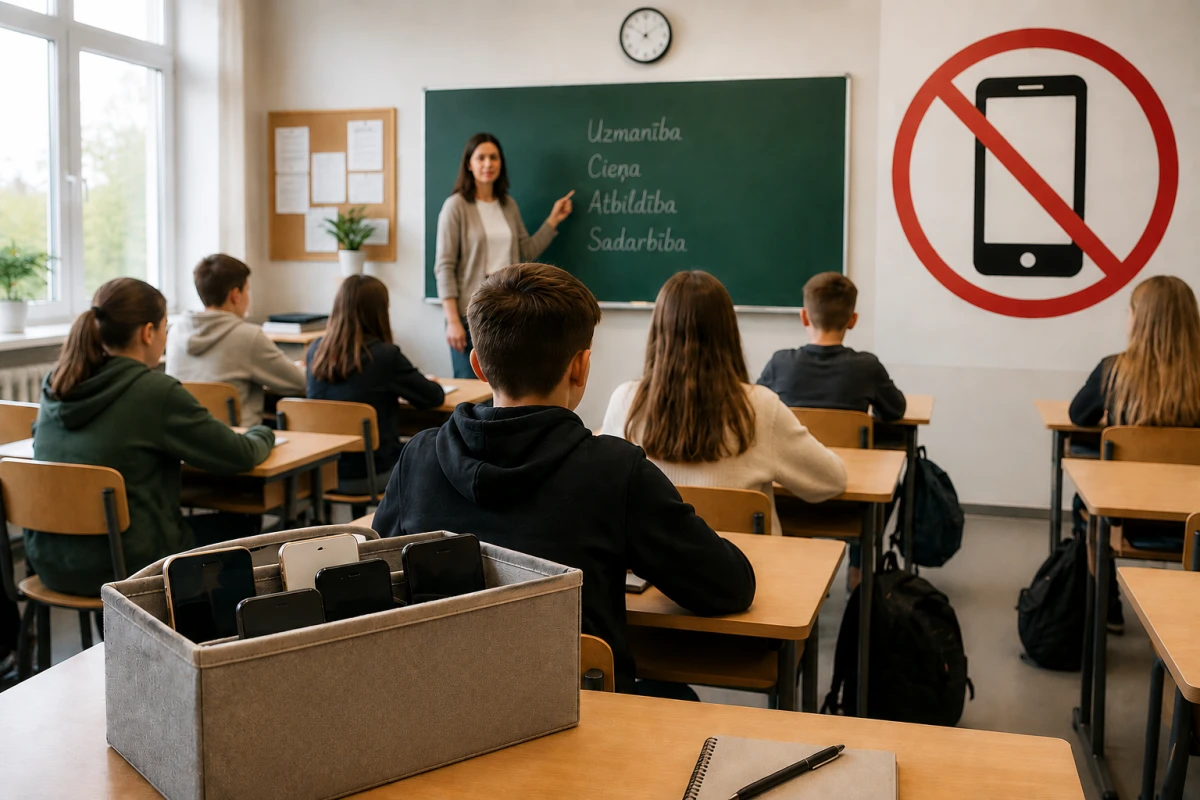
Starting June 1, amendments to the education law in Latvia will prohibit students from 1st to 9th grade from using mobile phones without a teacher's permission. In practice, the new rules will take effect in September, as students are already on summer break.
In Latvia, restrictions on the use of mobile phones in schools are being expanded. Previously, the ban applied only to students up to the 6th grade, but now it will be enforced for all students from 1st to 9th grade inclusive.
According to amendments to the education law, mobile phones can only be used during the educational process in cases where permitted by a teacher or when the device is necessary for completing educational tasks.
Formally, the changes will take effect on June 1, but their implementation will actually begin with the new school year, which starts in the fall. The authors of the initiative believe that expanding the ban will help students focus better on their studies and reduce the influence of digital distractions.
Chairwoman of the Saeima Education, Culture and Science Commission Agita Zarinja-Sture stated that the new order should serve as a clear signal for schools and their founders about the need to limit aimless use of mobile devices. According to her, studies show that even a turned-off phone nearby can affect a person's ability to concentrate and absorb information.
Additionally, one of the arguments in favor of the restrictions is the need to reduce the risks of digital bullying and emotional violence among children.
What is important to know: this is not a complete ban on phones in school. Devices can still be used for educational purposes if this is provided for in the lesson or permitted by the teacher.
Preparation for the new rules has been underway in advance.
Last year, the parliament adopted amendments that impose restrictions for younger students, and educational institutions were instructed to develop their own procedures for the use of digital devices by the end of May.
Now each school will need to determine how phones will be stored during classes, who will monitor compliance with the rules, and under what circumstances exceptions may be made.
The expansion of the ban reflects a trend that is gaining momentum in many countries around the world. More and more states and educational institutions are trying to find a balance between the use of digital technologies in education and the need to protect children from constant exposure to screens.
Starting in September, the new rules will affect almost all students in Latvia's primary schools.










Leave a comment