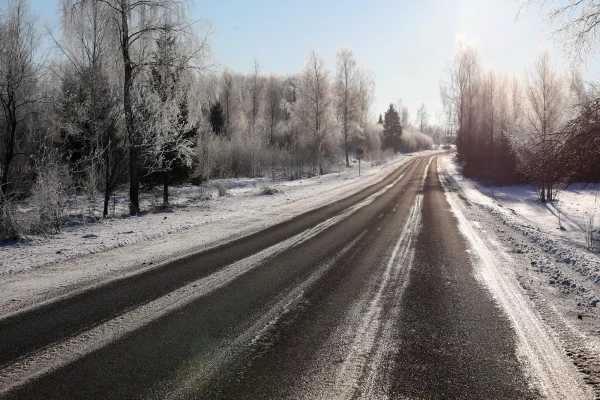
According to forecasts, frost will persist across Latvia in the coming days, with air temperatures dropping to -11…-18 degrees. At night, in some areas, the thermometer may drop to -20 degrees. At such low temperatures, the wet salt used to reduce slipperiness becomes less effective.
In light of this, during severe frosts, Latvijas Valsts ceļi urges drivers to be especially cautious:
• plan for more time on the road;
• consider the condition of the roadway;
• choose a safe driving speed;
• maintain distance;
• ensure that the vehicle is properly prepared for winter conditions.
Latvijas Valsts ceļi reminds that in snowy winters, a small amount of snow will always be present on the roadway — it accumulates due to traffic, comes onto the roads from the shoulders, from vehicles, and also remains after clearing in the form of a compacted layer. As a result, a mixture of snow with sand and salt forms, which salt begins to affect only under the influence of vehicle movement.
The head of the road maintenance company VAS Latvijas autoceļu uzturētājs (LAU), Vilnis Vitkovskis, notes that on class A roads, the main reagent for reducing slipperiness is technical salt (NaCl). However, at low temperatures, its effectiveness is limited, so in some cases, a sand-salt mixture or sand is used to improve driving conditions. On other roads, sand or a sand-salt mixture is also used in accordance with technical requirements.
According to Cabinet rules, under stable weather conditions, a snow or ice layer of up to 1 cm is allowed on state highways and other roads with high traffic intensity (class A). For class B and C roads, up to 4 cm and 10 cm are allowed, respectively. For low-traffic roads, this indicator is not established.
Gravel roads are maintained in winter with a compacted snow cover, and to reduce slipperiness, they are graded with a grader or the blade of a truck. Salt is not used on gravel roads, as it melts the upper layer of the surface, leading to over-saturation, the formation of potholes, and subsidence. Dangerous areas — turns, elevations, inclines, and declines — are sprinkled with sand.
It should be noted that roads are completely cleared of snow only after the snowfall has ended or after reaching the thickness of snow or ice allowed for the corresponding maintenance class. The time allocated for clearing ranges from three hours on high-traffic roads (class A) to 24 hours on roads with lower intensity. For local low-traffic roads (class D), specific snow clearing deadlines are not established.
State highways are divided into four maintenance classes — A, B, C, and D, where the main criterion is traffic intensity: the higher it is, the higher the maintenance class. Different sections of the same road may have different classes. All state highways belong to class A — the highest. Maintenance work is carried out in priority order according to classes: the most heavily trafficked roads are serviced first.
Drivers are urged to use the 24/7 free information line of VSIA Latvijas Valsts ceļi (LVC) at 80005555 to report icy conditions, potholes, snow drifts, or other issues observed on the roads. Information is promptly relayed for necessary work.