
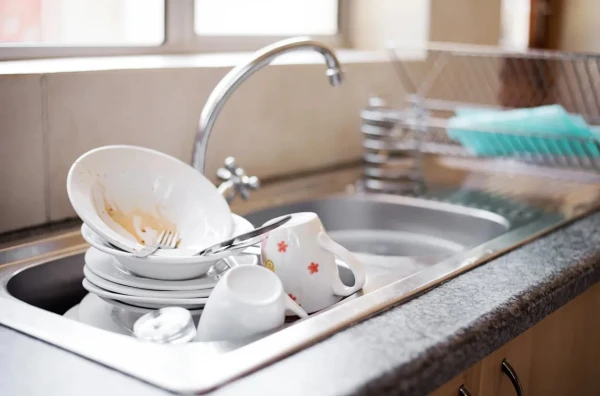
Leaving dishes in the sink is often perceived as a sign of laziness or lack of discipline. However, psychologists note that household habits may reflect not so much an attitude towards order, but rather thinking patterns and resource allocation. What appears to be "putting off for later" is often related to overload, priorities, or even certain personality traits.
Rest is More Important Than Strict Routine
Some people consciously postpone household chores to recharge first. This is not necessarily related to irresponsibility, but rather a choice in favor of rest after a busy day.
Decision Fatigue
After a large number of tasks and decisions, even simple actions can seem complicated. In such a state, the brain experiences overload, and household chores are automatically postponed.
Tendency Towards Creative Thinking
Research shows that in a less organized environment, people often demonstrate more original thinking. A little mess can foster unconventional ideas.
Focus on What Matters
People who leave dishes often concentrate on tasks they consider more significant. Household chores, in this case, take a back seat.
Varying Conscientiousness in Different Areas
A person can be disciplined at work and less demanding of themselves at home. This is not a contradiction, but a feature of attention and energy distribution.
Hidden Perfectionism
Sometimes, the refusal to tackle simple tasks is related to the desire to do everything perfectly. If there is no opportunity to do something "the right way," a person may postpone it altogether.
Focus on the Present
People who tend to leave dishes often immerse themselves fully in the current moment — in work, communication, or relaxation. They leave household tasks for "later."
Flexibility and Adaptability
Comfort with a little mess may indicate an ability to adapt more easily to changes and not get fixated on strict rules.
High Mental Load
Regularly accumulating dishes can be a signal of overload. When the brain is occupied with many tasks, even simple actions require more effort than usual.















Leave a comment