Artificial intelligence helped identify the purpose of the artifact.
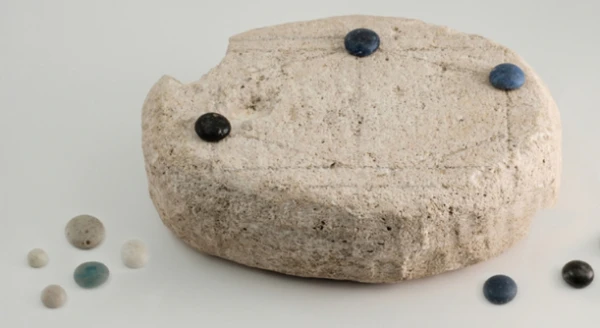
A gray limestone slab that has been stored for decades in the Roman Museum of the Dutch city of Heerlen turned out to be a board for a board game. If the reconstruction of its rules is correct, it is the oldest strategic game involving blocking the opponent. The discovery is reported in the journal Antiquity, with the first author of the article being Walter Crist from Leiden University.
This stone was discovered in the late 19th century during excavations at Coriovallum. It was a Roman town in the province of Lower Germany, founded during the reign of Emperor Augustus (27 BC – 14 AD) and existing until the fall of the Western Roman Empire in 476 AD. Coriovallum was located at the crossroads of major Roman roads in the province and therefore thrived. Its wealth is particularly evident in the monumental architecture and burials from the 2nd century AD. From the mid-1st to the 3rd century, the town was also an important center for pottery production. At its peak, the area of Coriovallum reached nearly 48 hectares. The remains of the ancient town lie beneath modern Heerlen.
The slab identified as a board game is dated quite broadly to the 2nd to 4th centuries. It is oval in shape, relatively small – 21 × 14.5 centimeters. The sides of the slab are carefully smoothed. On the front side, a rectangle is drawn, divided in half. Additional lines are drawn along its long edges, and the corners are separated by diagonal lines. Such a layout had long been suspected to represent a game, but it did not match any known Roman "boards."
To test the hypothesis, researchers examined the surface of the stone under a microscope and also created high-resolution 3D models of it. This allowed them to discover microscopic grooves left from the movement of pieces across the slab.
To reconstruct the rules of the game, researchers turned to the Ludii system. This is an artificial intelligence platform capable of modeling and determining the rules of historical and traditional games. The reconstruction methodology was quite simple: the exact geometry of the layout was entered into the system, which then compared it with a database containing the rules of hundreds of board games recorded in Europe and other regions. Two AI agents then played millions of virtual games on the stone from Coriovallum, testing and combining different sets of rules.
The modeling showed that this was a strategic game involving blocking. In such games, the goal is not to capture enemy pieces or race across the board, but rather to gradually immobilize the opponent's pieces. Players, each with several pieces, moved them across the board, trying to block paths and corner the opponent. Notably, in this game, AI players most often moved pieces precisely where the deepest grooves were found on the stone.
This discovery allows for a different perspective on the history of board games. Previously known Roman games belonged to other genres, such as those focused on capturing pieces or speed, while the earliest blocking games dated back to the Middle Ages. The game from Coriovallum turns out to be the first of its kind – five to seven centuries older than other representatives of the genre.