Tourists had to behave as if they were in a library.
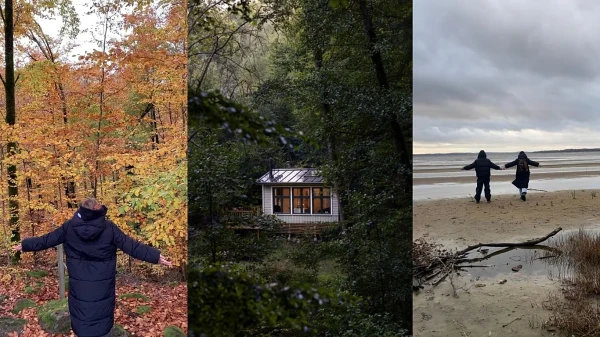
The Swedish region of Skåne has launched an unusual tourism campaign. This southern region is looking for travelers willing to spend a few days in a cabin in the woods.
The offer is free, but with one condition. Participants had to keep all sounds below a certain level; too loud sounds meant that the stay would suddenly end.
The team wanted to give people the opportunity to experience what happens when everyday noise disappears.
"The initiative became a kind of live experiment to see how participants would feel spending a few days surrounded by nature, without screens, distractions, and noise," adds Nordgren.
Visit Skåne also wanted to show that modern travel does not necessarily mean doing more.
"Sweden, and especially Skåne, offers what is becoming increasingly rare in the world: access to authentic silence," says Nordgren. "We wanted to emphasize that silence is not emptiness, but a resource that supports both people's well-being and sustainable tourism."
She also notes that in Sweden, nature is easily accessible thanks to "Allemansrätten," the right of everyone to free and respectful access to nature, including private lands. Three pairs were chosen to participate — from Denmark, Germany, and the United Kingdom.
Holm applied together with her sister. "Everyday life can be very fast and noisy, so I thought this challenge would help us reconnect with ourselves and nature," she says.
In childhood, they spent vacations at campsites and still explore Europe in vans and tents, so Stay Quiet became just the challenge they needed for relaxation.
The only real rule for staying in the cabin was to keep sounds below 45 decibels — about the same as in a library or a quiet office.
According to Holm, adhering to this limit was not difficult, except that sometimes it was hard to communicate with her sister because they had to speak in whispers.
"For us, maintaining silence in this peaceful corner of nature felt like the only right thing to do," she says.
She only felt like being loud once: when she "was so overwhelmed with pure happiness that she could have screamed to show it to the whole world."
Holm says there was plenty to do without noise and screens. They built campfires, cooked over the fire, admired the autumn foliage, and reflected a lot.
The cabin was prepared with creative activities, such as writing a letter to oneself in the future. "It was all about new adventures and discoveries: going deep into the forest in the middle of the night without light, cooking food over the fire, feeling a strong connection with the surrounding nature, and becoming incredibly calm and rested thanks to the silence," she says.
"Silence also helped me feel as balanced and calm as I haven’t felt in a long time."
Holm's stay turned out to be successful for both herself and Visit Skåne.
As Nordgren explains, "the idea was never about strict silence, but about mindfulness, helping guests understand how their own sounds interact with the sounds of nature and how silence feels when it is real."
Holm says she wants to carry the joy and tranquility she experienced in the cabin into her everyday life.
"During those days in the cabin, I felt incredibly calm, happy, inspired, and fulfilled, so now I want to find a similar place for myself, as well as for friends and family," she says.
"And above all, I want to spend more time in silence because it helps me hear my inner voice even better."