
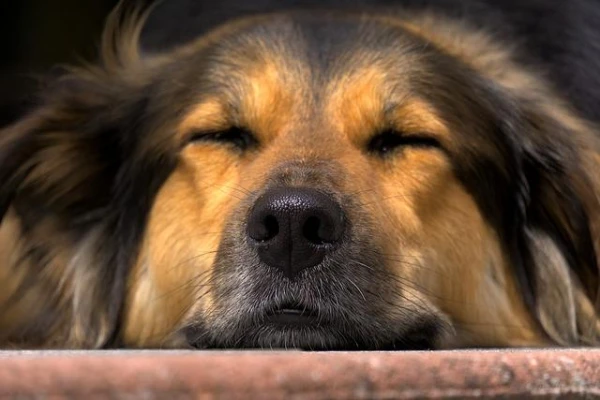
Dog owners are well aware of their pets' 'secret weapon' when it comes to begging for treats. The sad and bottomless eyes of our four-legged friends are almost impossible to ignore! But how did dogs master this trick?
The large and sad eyes of dogs can 'win over' not only a sausage from your table but also a cozy spot under the blanket!
In 2019, researchers from the University of Portsmouth, studying the anatomical differences between dogs and wolves, discovered that during the process of domestication, dogs developed a small facial muscle that allows them to raise their eyebrows. Interestingly, this muscle is absent in wolves, leading the scientists to believe that it became necessary for dogs to communicate more effectively with humans.
Previous studies had already shown that eye contact with their owner is very important for dogs. Furthermore, some works demonstrated that people prefer breeds that can perform certain facial movements, particularly raising the inner eyebrow (this movement has been named AU101). “This movement makes dogs' eyes visually larger, giving them a cute 'puppy look,'” explains Bridget Waller, the study's author. “Moreover, this expression resembles the facial expressions of humans when they feel sadness.”
Scientists believe that AU101 plays an important role in the relationship between humans and dogs, as it can evoke a certain 'caring' response in people. To determine whether this physical characteristic is indeed a result of evolution during domestication, the researchers carefully examined both the anatomical and behavioral differences between dogs and wolves in their interactions with humans.
Upon detailed analysis of the soft tissues, the authors found that the tiny facial muscle known as the 'medial elevator of the eyelid' was present in almost all studied dogs and only in a few wolves. Behavioral studies showed that dogs performed AU101 movements with significantly greater frequency and intensity than wolves.










Leave a comment