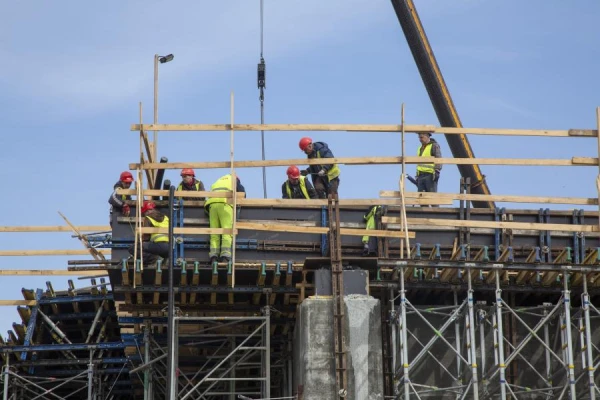
Latvia is short of about 20,000 workers. To compensate for the shortage, local companies are attracting willing workers from other countries.
The program "Nothing Personal" (TV3) has obtained a list of enterprises that invited workers from third countries last year. This includes over 2,000 enterprises, but most of them attracted fewer than 10 foreign workers.
Currently, stricter rules for attracting foreign labor are being discussed in the Saeima. Entrepreneurs are against this, believing that employers can take more responsibility for the invited workers themselves.
Almost one-fifth of all foreign workers arrived in Latvia at the invitation of the company "Kreiss," which is engaged in cargo transportation. Its turnover last year exceeded 230 million euros. The company did not comment on the situation with foreign workers. The remaining enterprises attracted fewer than 500 workers: 27 companies invited more than 100 foreigners, while about 1,720 invited fewer than 10. At the invitation of the construction company "PWT Group," 164 foreigners received work permits last year.
The list also includes companies founded by foreigners. For example, the Uzbek construction firm "Alif L M." At its invitation, 82 foreign workers received work permits last year. The company was founded in 2024, and officially, it employs seven people. It is registered at a building on Meness Street in Riga, but a representative of the company could not be found at the specified address. It is known that the Office of Citizenship and Migration Affairs prohibited "Alif L M" from inviting foreign workers for two years last year. Such a ban applies to companies that employ foreigners not in the profession specified in the invitation or accept those who have violated entry rules. If the office has suspicions of dishonest actions by the entrepreneur, the information is forwarded to the State Border Guard, which conducts an investigation.
"Last year, we identified 1,400 violations related to the stay of foreigners in Latvia - 44% more than the year before," noted the head of the State Border Guard, Guntis Pujats.
The most common violation is the discrepancy between the actual place of residence and the declared one. There are several hundred foreigners who have effectively disappeared, as the border service was unable to find them. Given the number of violations, Pujats believes that the attraction of foreign labor should be more strictly controlled. The Ministry of the Interior is also calling for this.