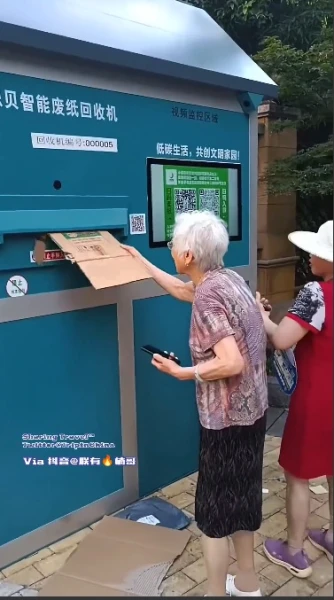
The equipment automatically weighs the items and calculates the payment based on the current rate.
In a residential complex in the Xihu District of Hangzhou, the administrative center of Zhejiang Province /Eastern China/, local resident Yuan Meijun opens the lid of a trash container and throws in bottles - the entire process takes less than 10 seconds. After that, a notification chimes on her mobile phone, and 0.8 yuan /11.6 cents USD/ is credited to her account.
"It's so convenient," she says, pointing to the smart waste collector. "Now I can easily dispose of boxes and bottles from packages for a small reward. It's great."
870 such smart waste collectors have been installed by the internet company Lovere, which specializes in waste recycling, in nearly 400 residential complexes in the Xihu District of Hangzhou since the project was launched in test mode in July 2024.
Local residents can enter their phone number or scan a QR code to recycle items such as plastic bottles, cardboard boxes, old clothes, takeout food bags, and plastic food containers. The equipment automatically weighs the items and calculates the payment based on the current rate of approximately 0.6 yuan per kilogram, which is credited directly to the user's account.
The waste containers are not just a convenience; they also demonstrate how technology monetizes waste streams in Chinese cities, helping to shift from a passive approach to active participation in circular economy processes.
Since the installation of the smart containers, the accuracy of recycling sorting has reached 98.5 percent, with an average monthly recycling volume of 1,000 tons, said Zhang Yixiang, a responsible representative of Lovere in Hangzhou.
Currently, Lovere's activities have expanded to 38 Chinese cities, where over 50,000 smart containers have been installed, recycling 2 million tons of waste, benefiting more than 30 million local residents.
In the Xihu District of Hangzhou alone, residents have used these waste collectors 2.58 million times, receiving monetary rewards totaling 4.2 million yuan. The most active user, according to the company, recycled 9 tons of waste, earning 5,400 yuan.
According to Zhang Kang, head of the production department at Lovere in Hangzhou, thanks to Internet of Things technology, sensors activate when containers are filled, and an automated sorting center categorizes recyclables into more than 80 types for further sale to downstream sector enterprises in the chain.
"It is expected that with scaling, the business will become profitable," he noted.
In the proposals of the Central Committee of the Communist Party of China for the development of the 15th Five-Year Plan for the country's socio-economic development /2026-2030/, a recommendation was made to promote the development of the circular economy.
On Xianyu, the leading platform for trading second-hand goods of Chinese internet giant Alibaba, an average of 7 million second-hand items were listed for sale daily in 2025, and the average daily trading volume increased by 30 percent compared to 2024.
"Every transaction is a user’s participation in an eco-friendly lifestyle," said Ding Jian, the CEO of this platform.
From April 2024 to March 2025, Xianyu users contributed to a reduction of carbon emissions by 11.8 million tons through participation in transactions and recycling, equivalent to the annual electricity consumption of 7.4 million households, said Ding Jian.
According to the China Association of Circular Economy, from 2021 to 2025, the circular economy accounted for about 30 percent of the reduction in carbon emissions in the country, and this share is expected to grow to 35 percent by 2030.
In the Yuhang District of Hangzhou, local resident Chai Yuyun highly praised the waste recycling service of the company Huge, whose employees picked up his old sofa and table for free just 20 minutes after he placed an order through the app.
Residents only need to place an order through the mobile app, and within an hour, a Huge worker arrives to collect, weigh, price, and pay for items such as old appliances and furniture.
"I live on a high floor, and it was difficult for me to throw away old bulky furniture by myself. Now, just by tapping the app icon on my smartphone, I can call these workers, and they will take away and dispose of unwanted furniture for free. It's a real relief," noted Chai Yuyun.
Hua Shaoping, deputy head of Huge Recycle, said that over the past 10 years, they have created the entire chain from household waste collection to sorting, dismantling, and resource reuse.
The service offers clearly defined prices for used appliances with various specifications, ensuring full pricing transparency. Residents receive payment in the form of "eco-credits," which can be exchanged for cash or spent in the Huge Mall online store, further encouraging eco-friendly consumption. To date, the company has issued eco-credits totaling nearly 500 million yuan.
Xu Lin, a professor at Zhejiang University, noted that thanks to smart technologies, waste recycling and eco-friendly consumption have become as simple as scanning with a phone. According to him, these small actions show how the public has shifted from being told what to do to taking the initiative in the circular economy.
"If the potential for public participation is fully realized, reducing carbon emissions will become a public consensus and a daily habit for everyone," added Xu Lin.